
You press the lever on your refrigerator door, expecting a crisp, cool glass of water… and nothing happens. Or, just as frustrating, you get a weak, slow trickle that takes a full minute to fill your glass.
When your refrigerator water dispenser is not working, it’s easy to assume a complex, expensive part has failed. But as appliance experts, we can tell you a secret: 99% of the time, this is an extremely simple problem that you can fix in less than 5 minutes, often with no tools at all.
Whether your dispenser is completely dead or your refrigerator water dispenser is slow, the root cause is usually one of three things.
Before you even think about calling a repairman, run through this ultimate fix-it guide. We will walk you through the 10-second “face-palm” fixes, the #1 most common part to fail (that you can replace yourself), and the advanced diagnostics. Let us get your water flowing perfectly again.
💡 Mentor’s Diagnostic Hub
Is your water dispenser just one of many issues? This guide is part of our comprehensive resource on diagnosing all refrigerator water and ice production problems.
The 3 “Quick Fixes” to Try First (The 60-Second Cures)
Start here. These three simple checks solve almost every dispenser problem.
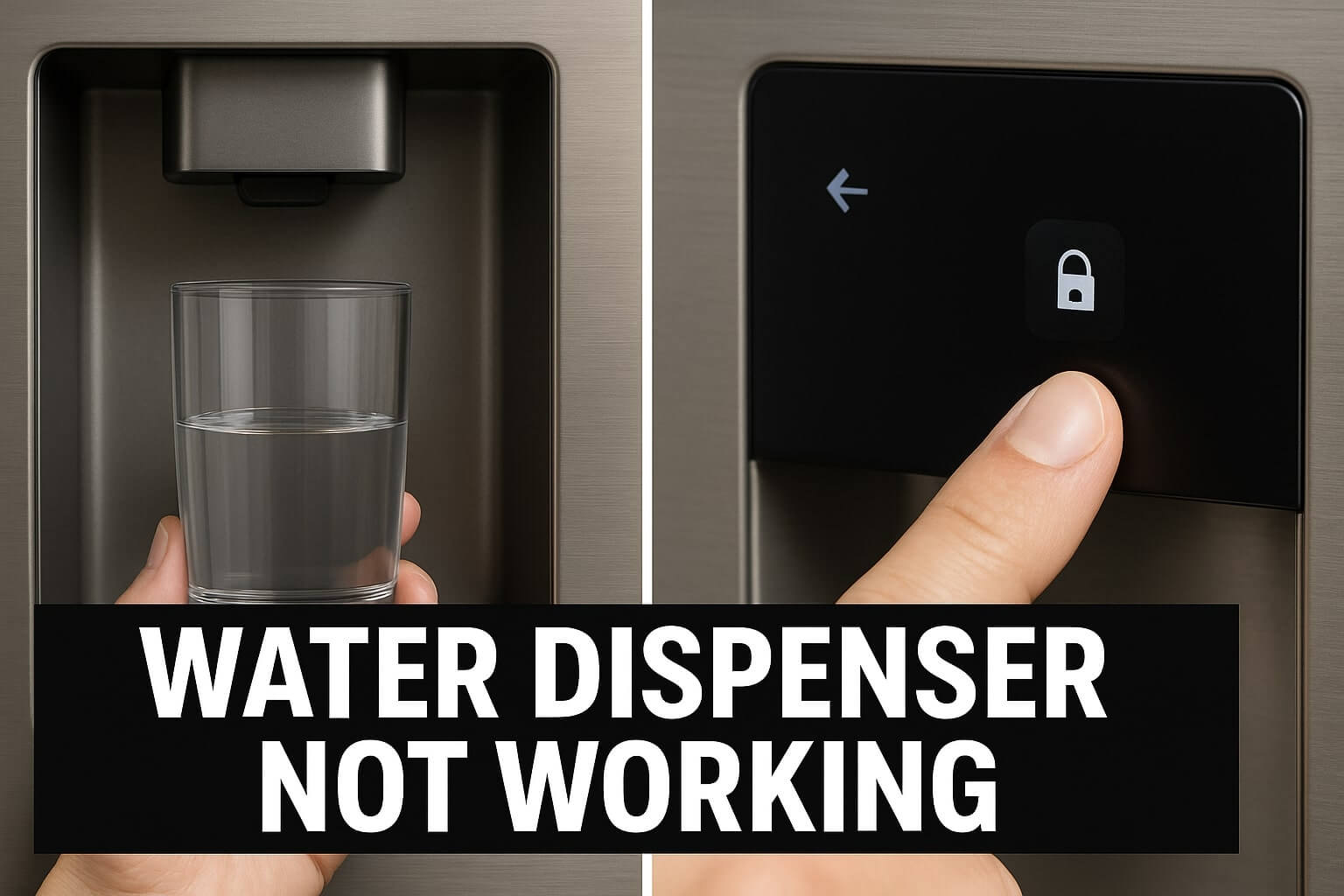
Fix #1: The “Child Lock” Is On (The 10-Second Fix)
This is, without a doubt, the most common “problem” we see. It’s the “face-palm” fix that gets 50% of people.
- The Problem: Every modern refrigerator with a dispenser has a “Child Lock” or “Control Lock” feature to prevent kids (or pets) from making a mess. When this is active, it completely disables the ice and water dispenser. You or a family member likely bumped the button by accident.
- The Fix: Look at your control panel. Do you see a small “Lock” icon lit up?
- On a Whirlpool/Maytag: It’s usually a button labeled “Lock” or “Control Lock.”
- On a Samsung/LG: It’s often not a dedicated button. You may need to press and hold the “Water” and “Ice” buttons at the same time for 3-5 seconds.
- Action: Press and hold the Lock button (or button combination) for 3 seconds. You will hear a beep, the lock light will turn off, and your dispenser will instantly start working again.
Fix #2: The Clogged Refrigerator Water Filter (The #1 Culprit)
This is the most common reason for a refrigerator water dispenser that is slow, and the second most common reason for one that’s stopped working completely.
- The Problem: Your refrigerator’s water filter traps sediment, rust, and minerals. Over 6-12 months, it gets so clogged that the water pressure drops to a trickle and eventually to zero.
- The Fix: If your “Change Filter” light is on (or if it’s been over a year), this is almost certainly your problem.
- How to Change It:
- Locate the filter: Usually in the top-right corner, the bottom kick-plate, or behind a door panel.
- Order the part: Get the correct replacement water filter for your model.
- Replace it: Most use a simple “twist-and-lock” or “push” system.
- Critical Step: After installing, you must flush it by running 1-2 gallons of water through the dispenser until it runs clear.

Fix #3: The Water Line in the Door Is Frozen
This is common if your dispenser is in the freezer door or if your freezer is set to a very low temperature (0°F / -18°C or lower).
- The Problem: The small plastic water line running through the door has developed a small ice-clog (an “ice dam”) inside it.
- The Fix: You need to gently melt this ice-clog.
- Thaw naturally: Turn your freezer temperature up slightly to 5°F or 10°F.
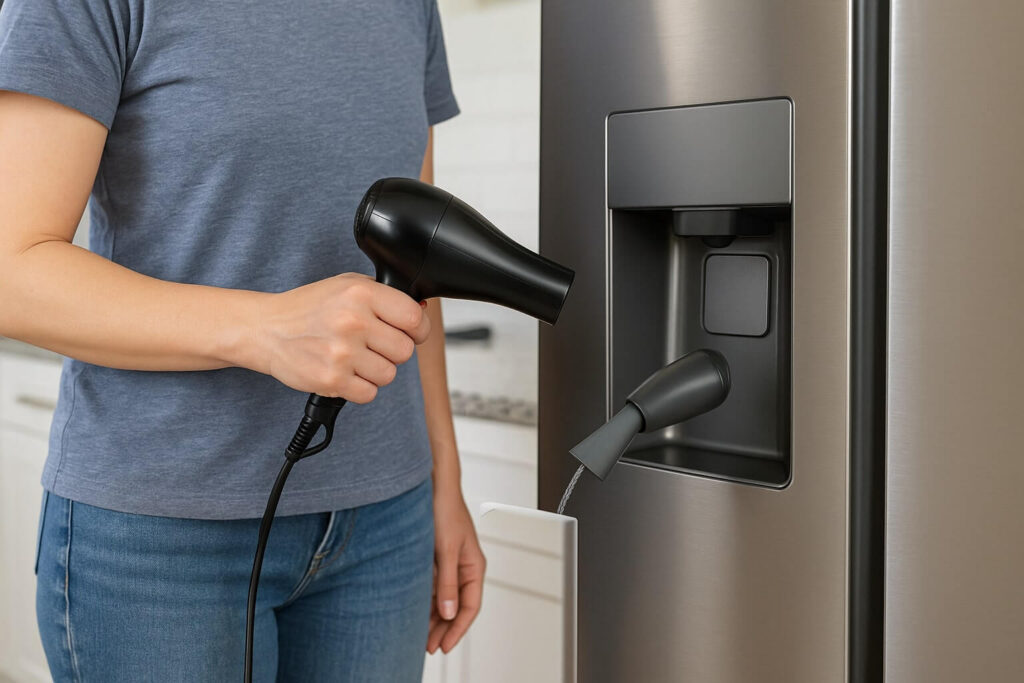
- Hairdryer method: Set a hairdryer to a low or medium heat setting. Wave it a few inches from the outside of the dispenser area for 3-5 minutes. Warning: Do NOT use a high-heat gun, as you will melt the plastic line.
- Hot water flush: If the spout is frozen, use a turkey baster to flush it with hot tap water from the outside in.
Advanced Troubleshooting: When the Quick Fixes Fail
If the lock is off, the filter is new, and the line isn’t frozen, you likely have a failed part. Here is how to check.
Problem #4: A Failed Water Inlet Valve
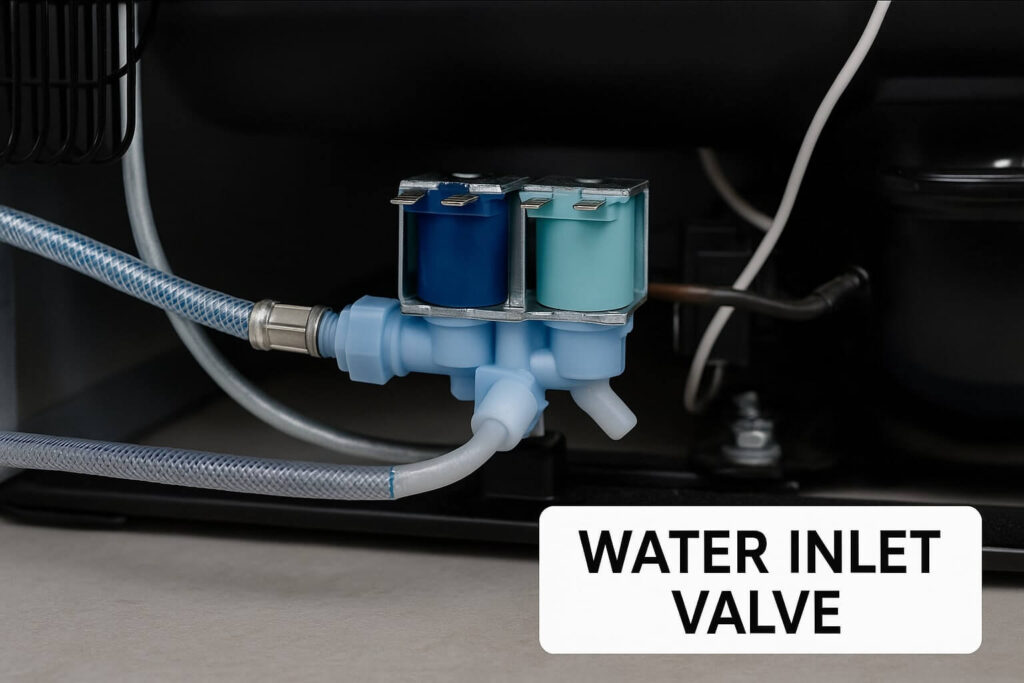
The water inlet valve is an electronic “gate” on the back of your fridge that opens to let water in.
- How to Diagnose: Pull your fridge out. Have someone press the dispenser lever while you listen behind the fridge. You should hear a distinct “CLICK-HUMMMM” from the valve.
- The Verdict:
- Loud Click-Buzz but no water: The valve is getting power but is mechanically stuck. It’s broken.
- Total silence: The valve isn’t getting power, pointing to a switch or board issue.
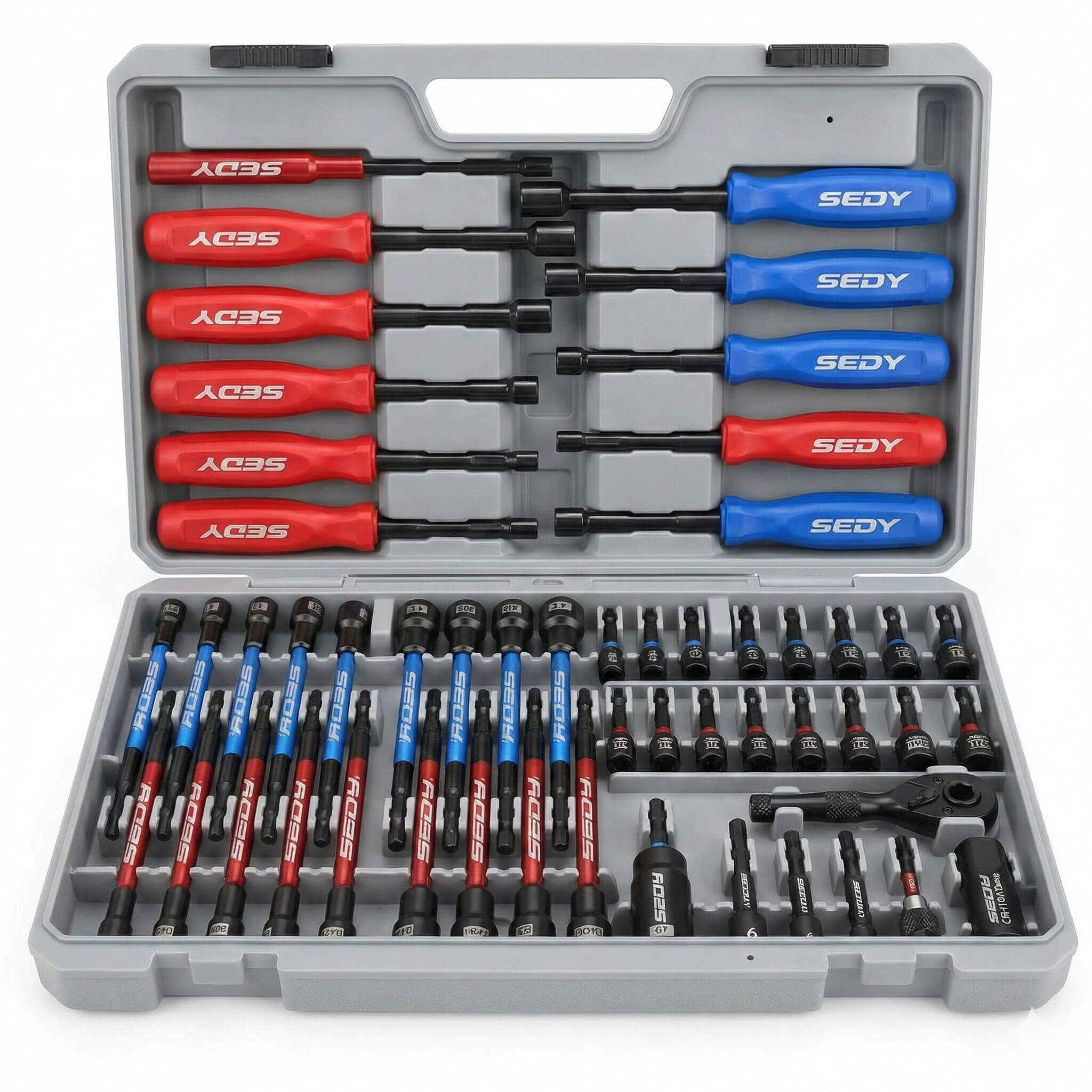
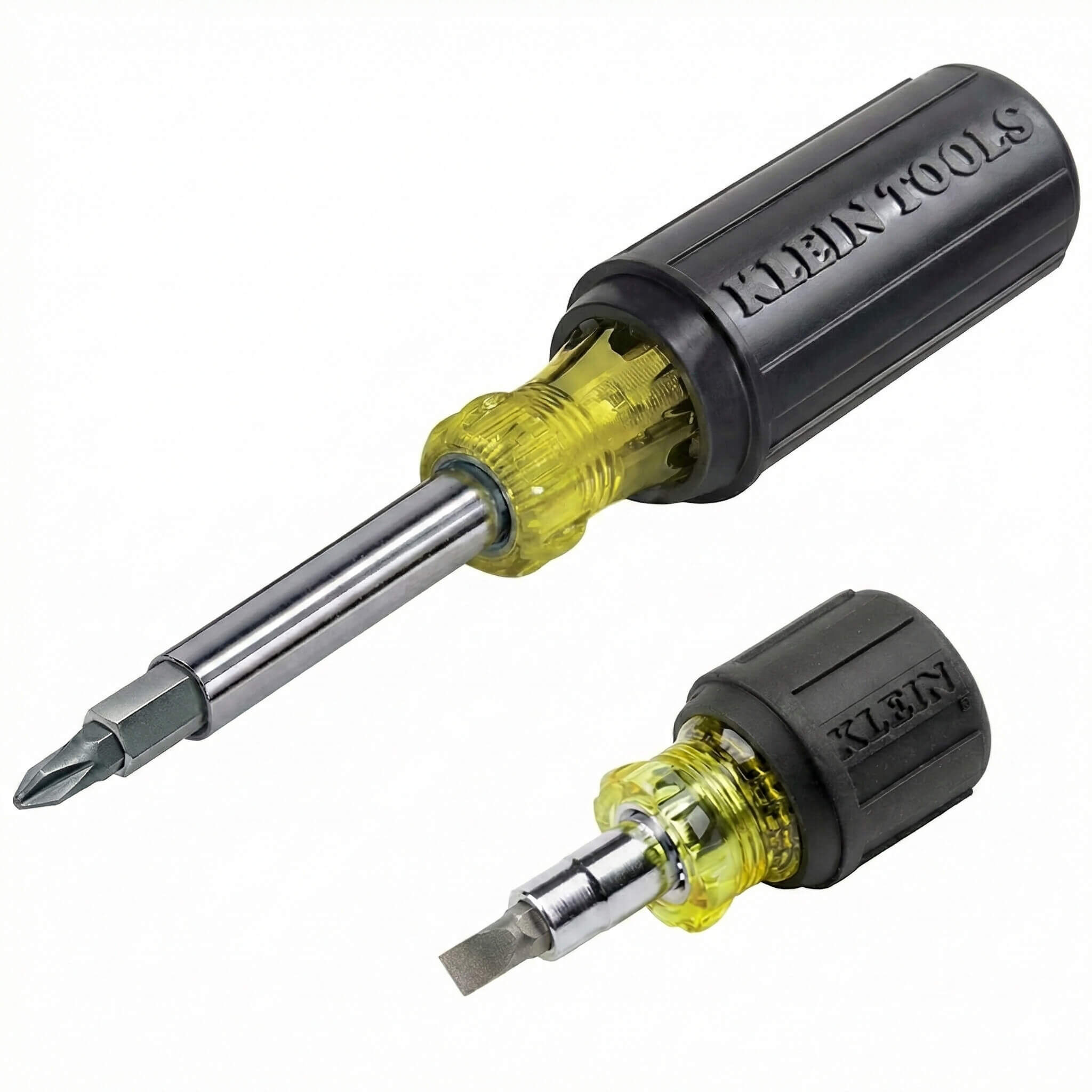
- The Fix: A water inlet valve is a replaceable part. It typically requires just a screwdriver and a wrench to swap once the fridge is unplugged.
Problem #5: A Broken Dispenser Switch or Lever
When you press the dispenser paddle, do you hear a faint “click” from inside the door panel before the back of the fridge hums? That click is the micro-switch. If you don’t hear it, the plastic lever has likely snapped or the switch has failed electrically. This requires disassembling the dispenser cover to inspect for damage.
Problem #6: A Kinked or Disconnected Main Water Line
If you recently moved the fridge, you may have accidentally kinked the main water line like a bent straw. Pull the fridge out and inspect the tubing for pinched sections. If it’s kinked, you’ll need to splice the section with a union connector.
Connecting the Dots: Related Problems
If both your water dispenser and ice maker are dead, the “Big 3” fixes (lock, filter, frozen line) are still the primary suspects. However, if those don’t work, it confirms a “main supply” issue, such as a failed inlet valve or a wall valve that is turned off. For more on the ice side of things, read our guide on why your ice maker is not making ice.
If you notice a puddle, refer immediately to our guide on why water is leaking inside your refrigerator, as a cracked main line can cause both a dead dispenser and serious floor damage.
Frequently Asked Questions (FAQ)
How do I reset my water dispenser?
Why does my new filter make the water taste bad?
Do I have to use the expensive “brand name” water filter?
Why is my water dispenser dripping?
Conclusion: Restore Your Refreshment
A non-working water dispenser is usually a simple fix. Start with the “Quick Fixes”—check your child lock, replace that old filter, and thaw any frozen lines in the door. By methodically moving from these easy solutions to advanced parts like the inlet valve, you can avoid an expensive service call and get your cold water flowing again today.