
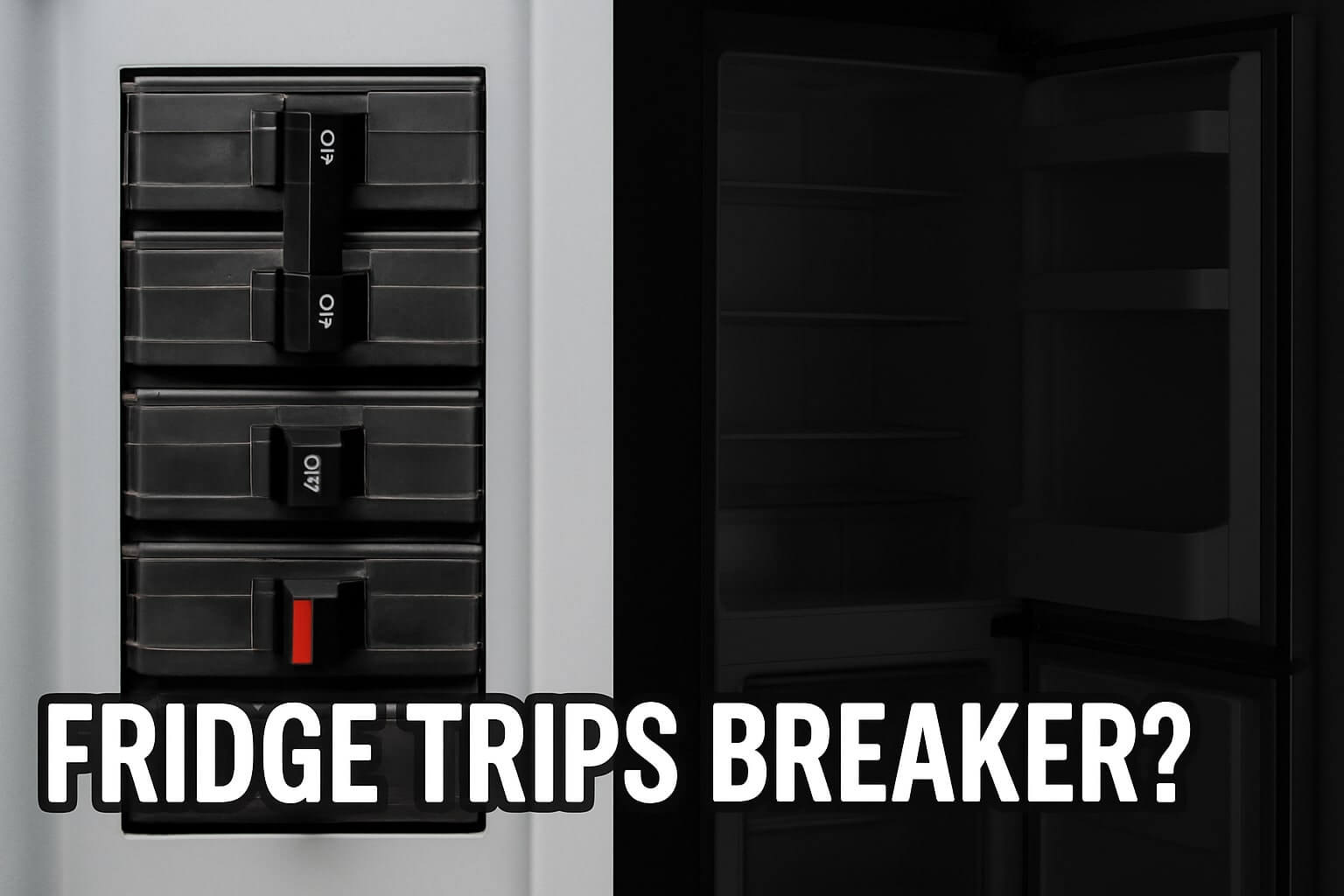
If you are struggling to figure out why your refrigerator keeps tripping breaker switches instantly, you are dealing with a serious safety feature activation. Unlike a slow cooling issue where you have time to react, a tripping breaker indicates a highly dangerous electrical short or a ground fault.
You plug your fridge in, and within seconds—SNAP. The lights immediately go out. Fortunately, the good news is that 50% of the time, the fridge isn’t even broken. Instead, it is simply plugged into the wrong type of sensitive outlet. However, the other 50% of the time, a specific internal component has failed catastrophically. In this guide, we will help you diagnose exactly why a refrigerator keeps tripping breaker panel and show you exactly how to fix it safely.
We will clearly explain the precise physics of a ground fault. Furthermore, we will explore why modern high-efficiency fridges absolutely hate GFCI outlets. Finally, we will teach you how to use a digital multimeter to pinpoint the exact part causing the short circuit.
💡 Mentor’s Diagnostic Hub
Electrical troubleshooting is the critical foundation of all major appliance repair. This specific guide serves as a core component of our comprehensive master series on diagnosing sudden power failures, dead control boards, and compressor lock-ups.
Reason 1: Refrigerator Keeps Tripping Breaker on GFCI Outlets
Before you tear your expensive fridge apart, carefully examine the wall outlet. Is it a standard electrical outlet, or does it feature distinct “Test” and “Reset” buttons in the middle? This specific type of receptacle is a GFCI (Ground Fault Circuit Interrupter).
If your fridge trips GFCI outlet buttons constantly, the issue likely stems from the hyper-sensitive outlet itself, not the refrigerator.
The Science Behind GFCI Nuisance Tripping
Refrigerators utilize incredibly large motors called compressors. When these heavy motors shut off after a cooling cycle, they naturally create a small “inductive kickback” of rogue electricity. Typically, a standard household breaker completely ignores this tiny fluctuation. However, a sensitive GFCI outlet actively measures the exact current going in versus the current coming out. It sees this tiny motor leakage as a lethal “shock hazard” and violently trips instantly.
The Extension Cord Diagnostic Fix
Ideally, you must move the fridge to a dedicated, standard, non-GFCI circuit. To test this theory safely, try running a thick, heavy-duty appliance extension cord to a standard outlet located in another room.
1. [Test Tool] Check Price for Heavy Duty Appliance Extension Cord on Amazon
If the fridge runs perfectly on the extension cord, you simply need to hire an electrician to change your kitchen outlet to a standard receptacle. Conversely, if the refrigerator keeps tripping breaker switches even on a standard outlet, proceed immediately to the next diagnostic step.
Reason 2: Refrigerator Keeps Tripping Breaker Due to Ground Faults
If your refrigerator keeps tripping breaker switches even on a standard non-GFCI outlet, you almost certainly have a dead short. Essentially, this means a live, high-voltage electrical wire inside the fridge is physically touching the bare metal frame.
This situation creates extreme danger. Therefore, you must never force the breaker switch to stay on. You must methodically locate the broken component that is actively “leaking” electricity directly to the ground.
The Defrost Heater Failure
The defrost heater usually sits directly beneath the freezing evaporator coils. As this high-voltage heater drastically expands and contracts daily, the fragile glass or metal tube can eventually crack open. Consequently, this crack allows the live inner heating wire to directly touch the wet metal coils. This creates an instant ground fault the exact second the defrost timer activates.
The Compressor Motor Burnout
The heavy compressor motor relies on thin copper wire tightly wound inside a metal casing. A special protective varnish thoroughly coats this copper wire. Over many years of intense heat, this vital varnish inevitably melts away. As a result, the bare copper wire touches the compressor’s metal shell. This shorts out the entire appliance instantly upon startup.
The Water Inlet Valve Short
Modern refrigerators feature electronic water inlet valves to supply the ice maker. Occasionally, the plastic water tubing develops a microscopic pinhole leak. This water quietly drips directly onto the live electrical solenoids located at the bottom rear of the fridge. Water easily bridges the electrical gap, creating a massive short circuit that trips your main panel.
Tools You Will Need to Fix a Tripping Breaker
To find the precise short circuit without dangerously blowing your house fuses ten times in a row, you need specific diagnostic tools. You must test for continuity (electrical resistance) using a proper meter.
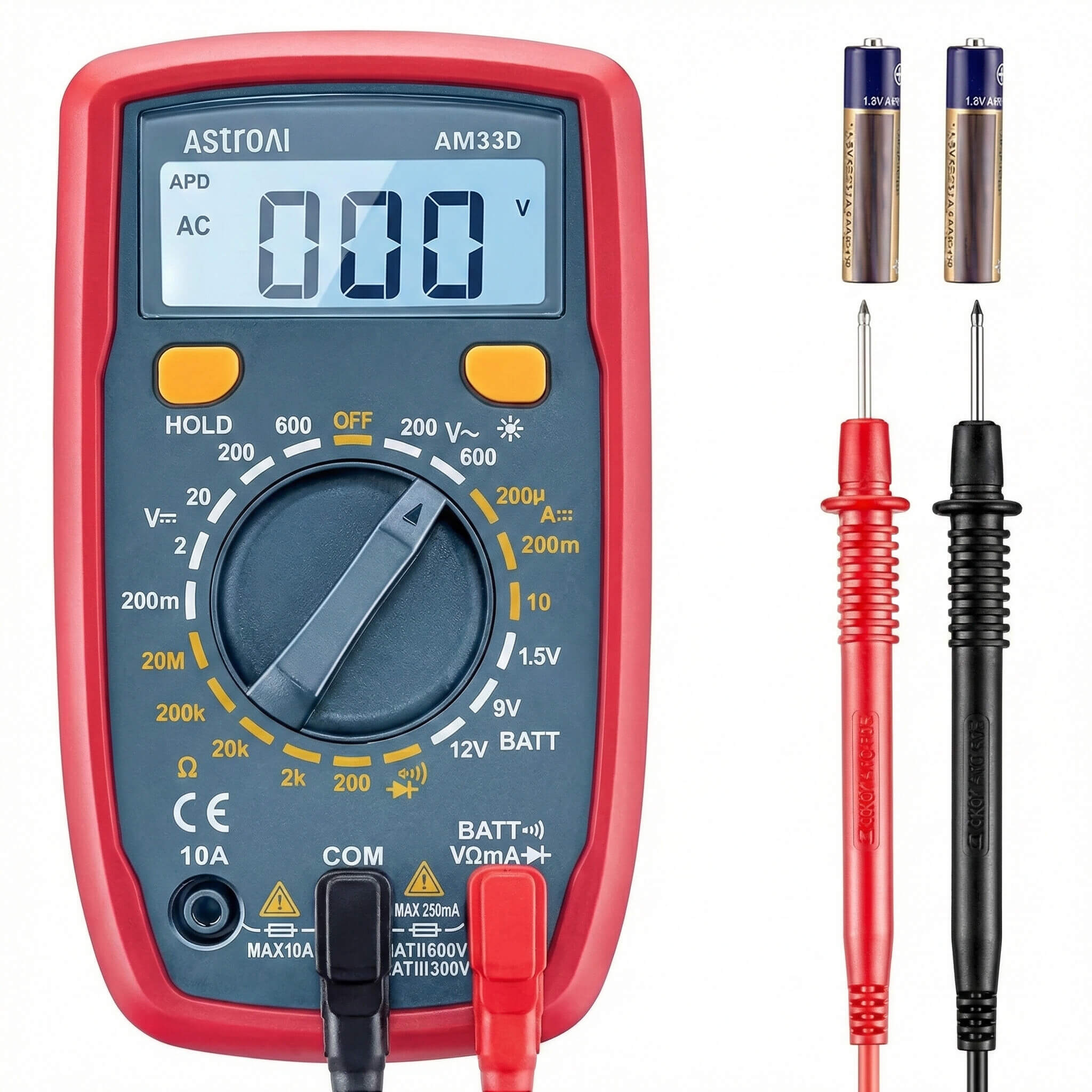
- Digital Multimeter: This is absolutely essential for your personal safety. You cannot diagnose a short without one.
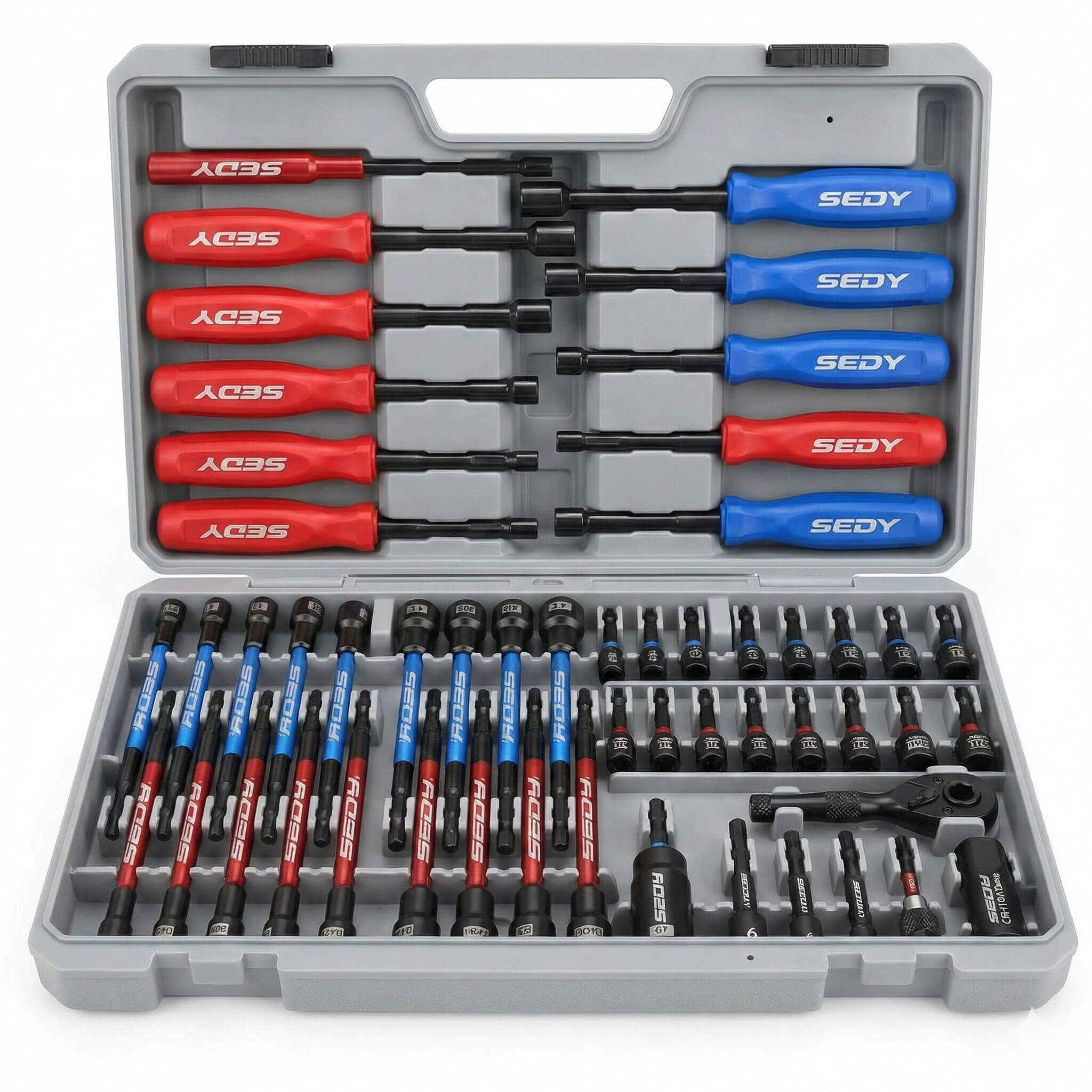
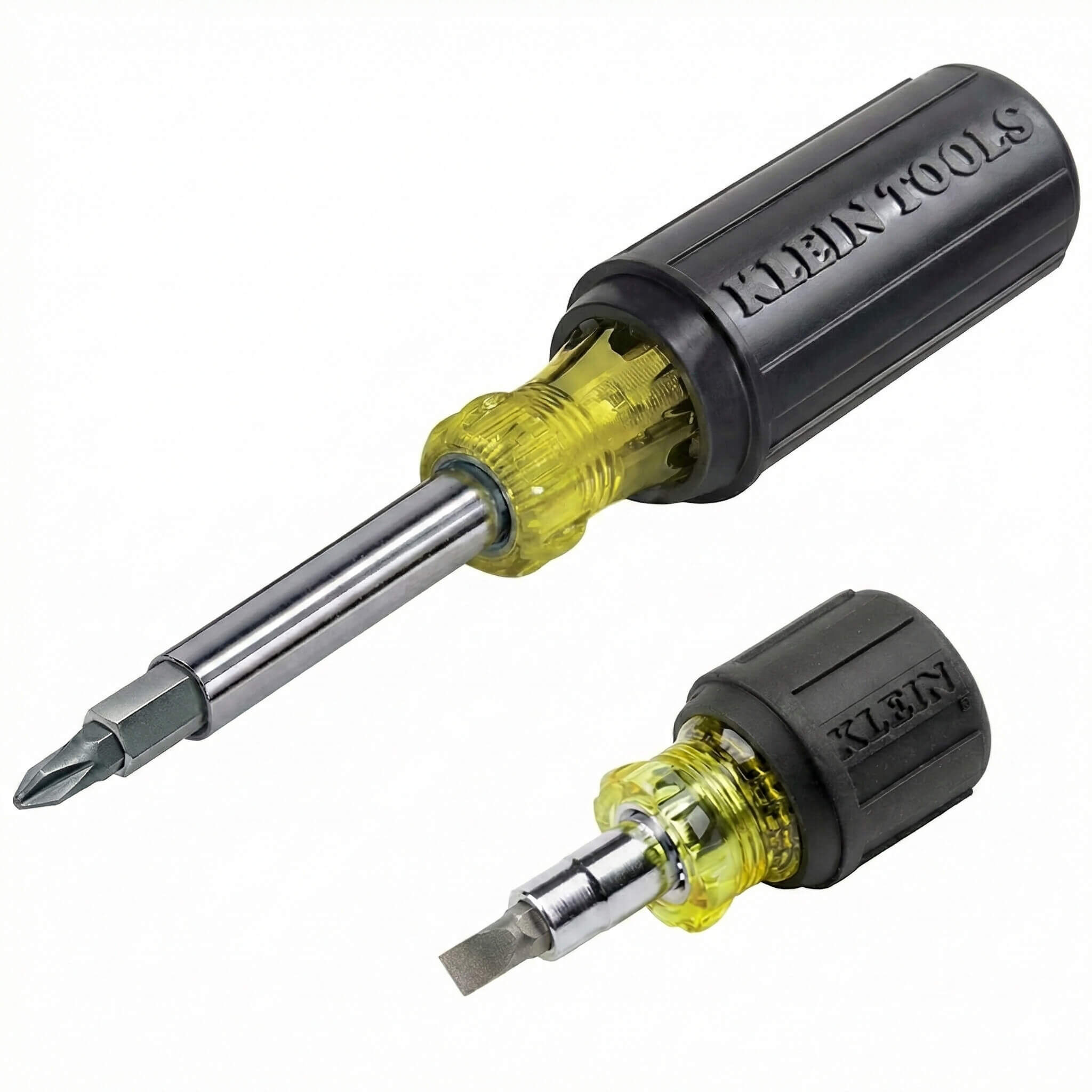
- Magnetic Screwdriver Set: You need this to remove the back panels safely without dropping screws into the motor compartment.
- Bright Flashlight: You must closely inspect the dark, hidden wiring harnesses for hidden scorch marks.
2. [Essential Tool] Check Price for Digital Multimeter on Amazon
Step 1: Isolate Why Refrigerator Keeps Tripping Breaker
If you don’t own a multimeter yet, you can still use simple deductive logic to isolate why the refrigerator keeps tripping breaker. This practical method involves unplugging internal components one by one until the breaker stops tripping.
Warning: You must unplug the main fridge cord from the wall every single time you touch an internal wire!
The Disconnection Process
- First, unplug the fridge entirely.
- Disconnect the Ice Maker: Find the plastic wire harness for the ice maker located inside the freezer ceiling and unplug it. Next, plug the fridge back into the wall.
- Did the breaker trip?
- Yes: The ice maker is fine. Move on to the next step.
- No: You found the problem! Simply replace the broken ice maker unit.
- Disconnect the Defrost Heater: Remove the interior freezer back panel. Unplug the two wires leading to the glass heating element at the bottom of the silver coils. Then, plug the fridge back in.
- Did the breaker trip?
- No: You successfully found it! The heater possesses a severe ground fault. Replace the heater assembly.
- Disconnect the Compressor: Remove the lower rear cardboard panel. Unplug the plastic Start Relay directly from the side of the black compressor tank. Finally, plug the fridge back in.
- Did the breaker trip?
- No: Your compressor suffers from an internal dead short. Unfortunately, this represents the worst-case scenario requiring professional replacement.
Step 2: Test Why Refrigerator Keeps Tripping Breaker with Multimeter
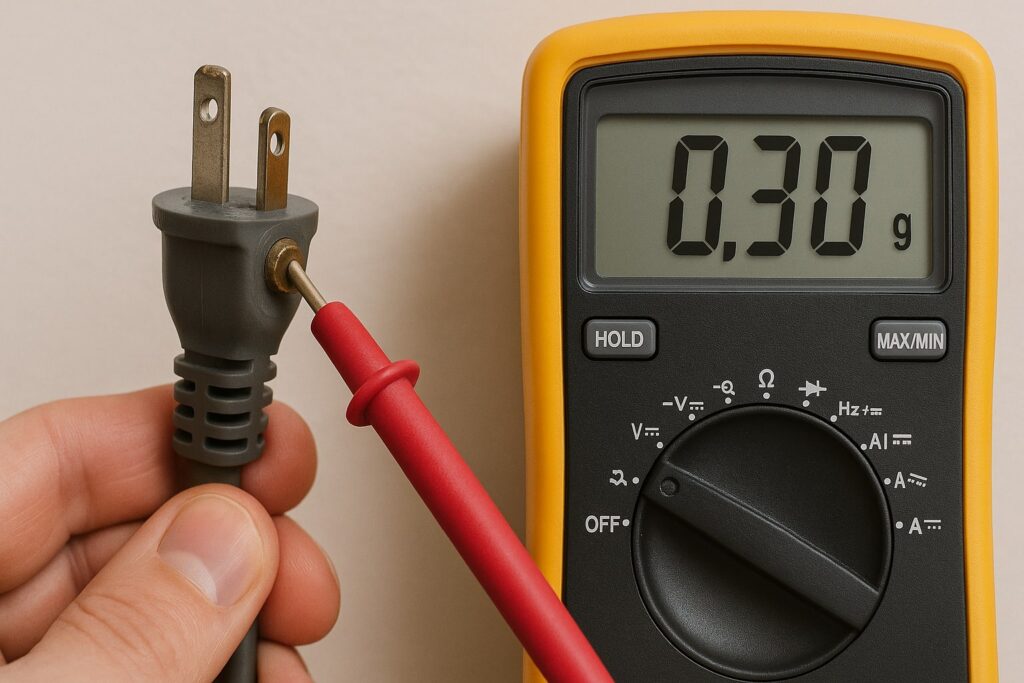
The safer, highly professional way to stop the refrigerator keeps tripping breaker cycle involves testing the main power plug itself with a digital meter. This keeps you safely away from live electricity.
The Main Plug Ground Test
- First, ensure the fridge remains completely unplugged from the wall.
- Second, set your digital multimeter to the highest Ohms (Resistance) setting, or use the loud Continuity beep mode.
- Next, firmly hold one multimeter probe on one of the flat metal prongs of the refrigerator’s power cord plug.
- Then, firmly hold the other multimeter probe directly on the Round Ground Pin of the exact same plug.
- Analyzing the Reading:
- “OL” (Open Loop) or Infinite: This result is GOOD. It definitively means electricity cannot physically flow from the main power line to the safety ground pin. The main wiring harness is safe.
- Any Number (0.01 to 500): This result is BAD. It clearly means there is a rogue electrical connection between the active power and the ground. Therefore, you have absolutely confirmed a massive short circuit.
Reason 3: Refrigerator Keeps Tripping Breaker Due to Overload
Sometimes, the expensive refrigerator functions perfectly fine, but the household circuit is severely overwhelmed. If your refrigerator keeps tripping breaker panels only when the microwave, blender, or toaster oven turns on simultaneously, the problem is simply the load capacity.
The Diagnosis of an Overloaded Circuit
A standard 15-amp kitchen circuit can safely handle only about 1,800 watts total before the breaker activates to prevent melting wires in your walls. A modern fridge uses roughly 500 to 800 watts during its intense startup phase. Consequently, if you run a powerful 1,000-watt microwave and a 500-watt coffee maker on that exact same circuit, you instantly exceed the strict physical limit.
The Simple Fix
You must meticulously map your electrical breaker box. Turn the kitchen breaker off and systematically check every single outlet to see what goes dead. Ultimately, ensure the refrigerator runs on its own dedicated electrical circuit, completely separated from heavy countertop heating appliances.
Reason 4: Start Relay Making Refrigerator Keeps Tripping Breaker
If the breaker only trips the exact moment the heavy compressor actively tries to kick on (usually accompanied by a distinct, loud click), you might simply have a blown Start Relay. This damaged relay causes a massive momentary electrical arc.
Diagnosing the PTC Relay
Carefully inspect the small plastic relay attached to the side of the black compressor tank. Pull it off gently. Next, shake it next to your ear. If it loudly rattles when shaken or looks heavily burnt near the pinholes, replace it immediately.
Fortunately, this represents an incredibly cheap and fast DIY fix that very often solves the compressor start trips breaker issue without requiring a costly technician visit. Not sure how? Read our comprehensive guide on how to replace a start relay safely.
Reason 5: Physical Damage to the Wiring Harness
Sometimes, the root cause is entirely physical rather than mechanical. Homeowners frequently pull their refrigerators out to clean the dusty floor behind them. Unfortunately, when pushing the heavy appliance back into place, the sharp metal wheels can accidentally roll directly over the thick power cord.
The Crushed Cord Scenario
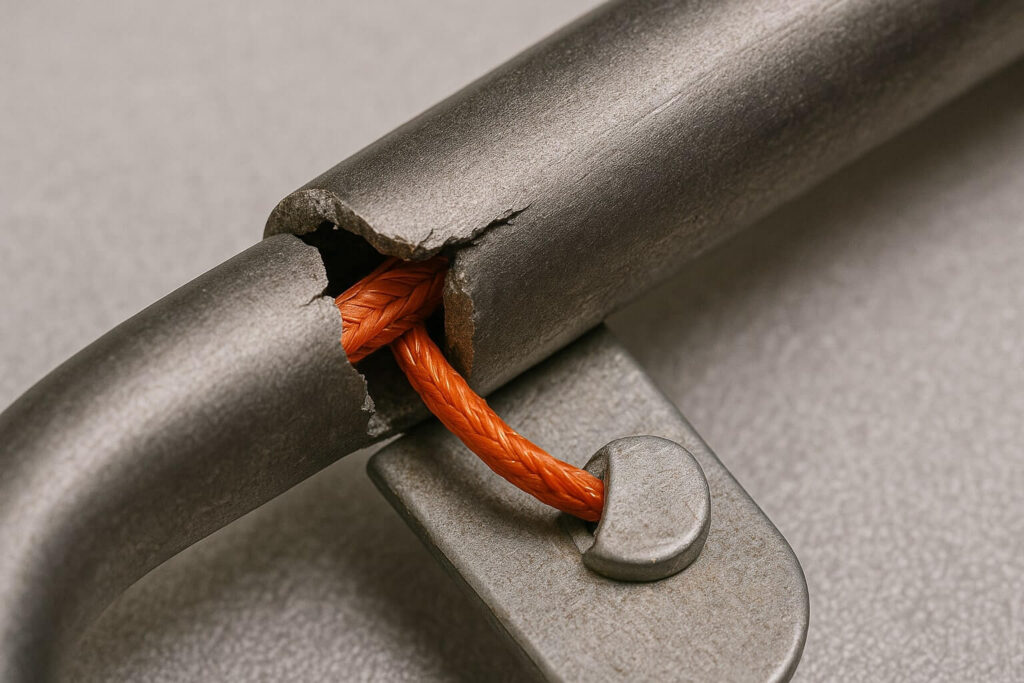
Rolling over the cord forcefully crushes the thick rubber insulation. As a result, it permanently pushes the hot wire and the neutral wire together inside the casing. The very next time you plug it in, the electricity takes the easiest path, instantly creating a massive arc and popping the breaker. Always visually inspect the entire length of your power cord for severe crimps, deep cuts, or exposed copper wire. If you find any damage, you must replace the entire cord assembly.
Reason 6: Main Control Board Catastrophe
Modern refrigerators essentially operate as giant computers. They utilize highly complex main electronic control boards to dictate every single cooling function. Occasionally, a massive power surge from a neighborhood lightning strike easily bypasses the surge protectors.
The Fried Capacitor
This rogue high voltage forcefully enters the main control board and completely destroys the large cylindrical capacitors. When a capacitor “blows,” it often physically splits open and shorts the entire electrical circuit board to the grounded metal casing of the fridge. Consequently, the second you provide power to the fridge, the damaged board instantly trips your house breaker to prevent a kitchen fire. You must remove the back access panel and visually inspect the green motherboard for dark black scorch marks or a sharp, burning ozone smell.
Frequently Asked Questions (FAQ)
Is it safe to replace a tripping breaker with a bigger one?
Why does my fridge trip the breaker only at night?
Can a bad start capacitor cause the breaker to trip?
How much does it cost to fix a shorted refrigerator compressor?
Will a surge protector stop my breaker from tripping?
Conclusion
Diagnosing exactly why a refrigerator keeps tripping breaker switches is essentially a logical, binary problem. Either the wall outlet is far too sensitive (like a GFCI receptacle), or an internal component is actively leaking lethal electricity directly to the metal ground.
First, always start by properly testing the wall outlet utilizing a heavy-duty extension cord. Next, if the outlet proves fine, use the methodical process of elimination to unplug the defrost heater, the ice maker, and the heavy compressor one by one.
Electrical appliance issues seem scary initially, but they operate entirely on logic. Once you safely pinpoint the precise component causing the dead short, simply unplugging that specific part is often enough to get your fridge running again safely while you wait for the replacement part to arrive in the mail.
If you confidently determined your compressor is the main issue, you might need to test its overall mechanical health. Check out our comprehensive guide on how to install a hard start kit to see if the expensive motor can be permanently saved.