
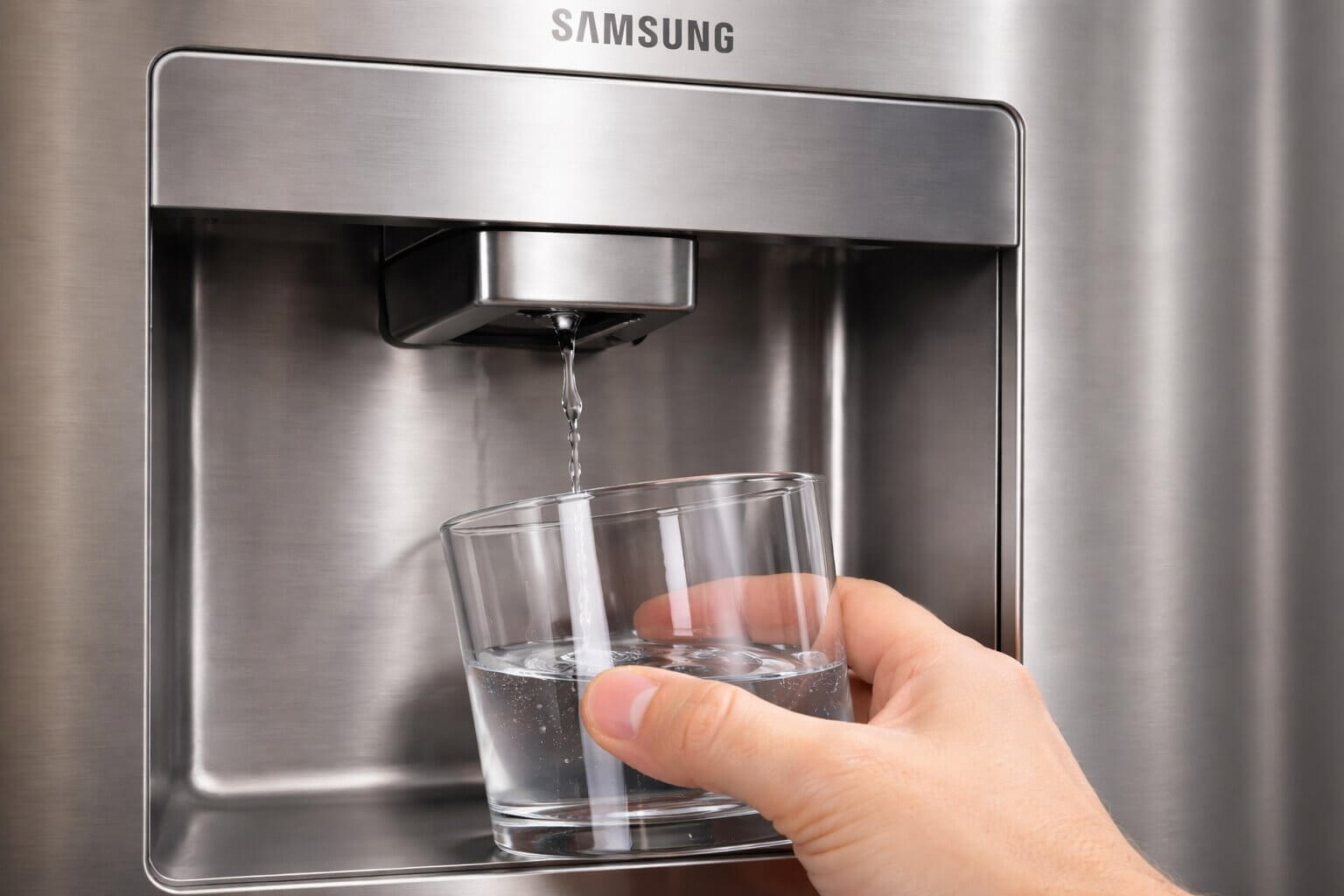
Picture this: It is a Saturday afternoon. You just spent $50 at the big box store on a brand new, genuine Samsung water filter because the annoying red light on your display panel finally guilt-tripped you into changing it. You carefully followed the installation instructions, locked the new plastic cartridge perfectly into place, and walked over to the front door to grab a well-deserved, refreshing glass of ice-cold water.
You press your glass against the dispenser paddle, fully expecting a powerful, crisp stream. Instead, the refrigerator violently sputters, makes a loud groaning noise, and spits out a pathetic, anemic trickle.
There is absolutely nothing more frustrating than performing routine, expensive maintenance on your kitchen appliance, only to feel like you completely broke it in the process. If you are currently standing in your kitchen wondering why there is slow water flow from your Samsung dispenser immediately after a filter change, take a deep breath and put the toolbox down. You did not break your refrigerator.
This is an incredibly common, highly documented physical phenomenon. A sudden drop in water pressure immediately following a filter replacement is almost never an electrical board failure or a broken pump. Rather, it is entirely dictated by simple fluid dynamics: trapped ambient air, unseated plunger valves, kinked hoses, or conflicting home plumbing systems. In this comprehensive diagnostic guide, we will walk you through the exact professional steps to safely purge the system, reseat the cartridge, and get your high-speed water flow back in under ten minutes.
💡 Mentor’s Diagnostic Hub
A drop in water pressure is a frequent side effect of replacing the filter cartridge. This specific guide is a core component of our comprehensive master series on Samsung water systems. For a complete overview of all filter types, reset codes, and compatibility charts, please refer to our main guide.
Reason 1: The Massive “Air Lock” Phenomenon
By far, the absolute most common cause of a sudden, sputtering trickle is a massive pocket of trapped air hiding inside your water lines.
When you take a brand new Samsung filter out of its plastic shrink wrap, the heavy internal coconut-carbon block is completely bone dry. The interior plastic chamber is entirely filled with ambient room air. When you lock that dry filter into the refrigerator’s manifold and turn the water supply back on, the heavy 60 PSI city water aggressively rushes into the back of the filter. Consequently, it violently pushes all of that trapped air forward, directly into the incredibly narrow 1/4-inch plastic water lines running up the back of your fridge and through your freezer doors.
Because air is highly compressible (unlike water), this massive block of trapped air actively creates an immovable “vapor lock.” The air bubble acts exactly like a solid physical cork, severely restricting all liquid from flowing past it. The fridge’s internal water valve opens, but the water literally cannot push past the compressed air wall.
The Fix: The Mandatory 3-Gallon Flush
You cannot simply dispense one cup of water and expect the pressure to magically return. You must aggressively and patiently force the air lock completely out of the intricate plumbing maze.
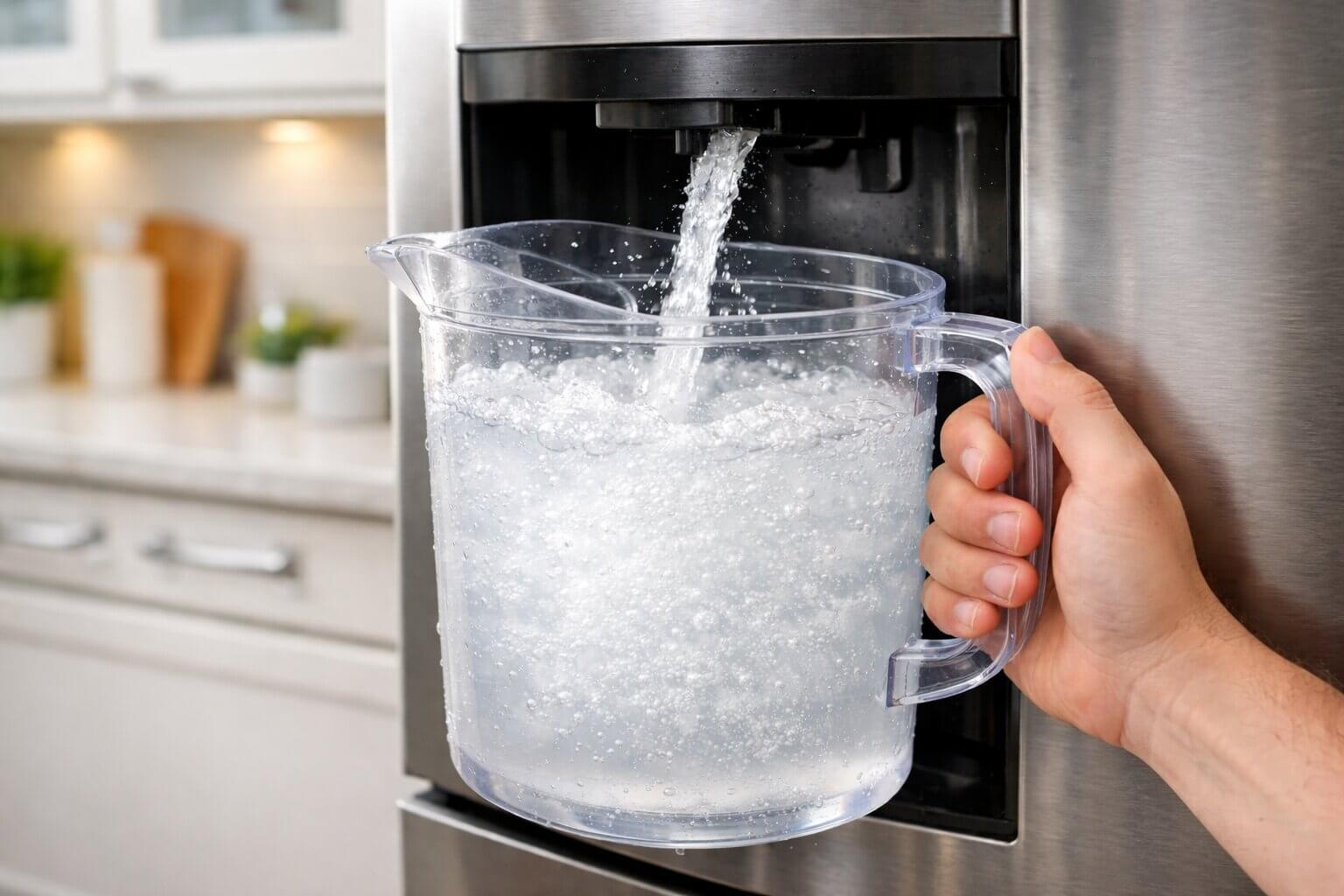
- Grab the largest kitchen pitcher or cooking pot you own. A standard drinking glass will overflow too fast.
- Press it firmly against the water dispenser paddle and hold it there. Do not let up.
- You must continuously dispense exactly 3 entire gallons of water safely down the sink drain. (Depending on how slow your flow is right now, this usually takes roughly 5 to 7 straight minutes of standing there holding the paddle).
- Don’t Panic at the Sputter: Initially, the water will vigorously sputter, aggressively spit loud air bubbles, and splash. It will also likely look deeply cloudy, milky, or even gray. This is completely normal. It is just loose black carbon dust shedding off the new filter mixed with thousands of micro-bubbles. Keep holding the paddle. (Note: If the water eventually runs clear but you notice a strange flavor, read our guide on why your fridge water tastes bad after changing the filter).
- Once you hit that 3-gallon mark, the trapped air will physically clear the dispenser nozzle with a final “hiss,” and your high-speed, crystal-clear water flow will instantly return to normal.
Reason 2: The “Un-Seated” Internal Plunger Valve
If you patiently flushed 3 whole gallons of water, the air is definitively gone, but the flow is still a sad, anemic drip, you likely have an installation seating error.
Grab a flashlight and look deep inside the plastic filter housing (the manifold) inside your refrigerator. At the very back of that dark chamber sits a tiny, spring-loaded plastic plunger valve. When you fully and properly insert a filter, the tip of the filter physically depresses this plunger, opening the valve and allowing maximum water volume to enter the cartridge.
However, people are often terrified of breaking the expensive plastic housing, so they are far too gentle. If you gently slid the filter in without applying firm, aggressive inward pressure while twisting, the filter will successfully lock into the plastic tracks *without* fully depressing that internal plunger.
As a result, the main water valve remains 90% closed. The fridge thinks the filter is installed, and the filter won’t fall out, but the physical water pathway is severely choked off.
The Fix: The Aggressive Reinstall
- Turn off your main home water valve behind the fridge (this removes the intense line pressure, making the filter vastly easier to turn).
- Twist the filter counter-clockwise and completely remove it. (If it is completely locked up and refuses to turn, check our detailed guide on Samsung water filter stuck removal).
- Inspect the two black rubber O-rings at the tip of the filter to ensure they aren’t torn, dry-rotted, or twisted out of their grooves.
- Push the filter back into the housing. This time, apply significant inward force directly toward the back wall while simultaneously twisting it a full, undeniable 90 degrees to the right. You should feel a distinct “thud” as it seats.
- The padlock icon on the filter must align absolutely perfectly with the arrow on the housing. Turn the water back on and test the flow.
Genuine Samsung HAF-CIN/EXP Water Filter
Why you need this: Sometimes, incredibly cheap generic eBay filters use oversized plastic locking teeth that completely fail to depress the internal plunger valve. If you are fighting low pressure, reverting to the exact factory OEM filter guarantees a perfect physical fit.
Not sure if your fridge uses the older style or the newer style? Read our comparison of the DA29-00020B vs HAF-QIN Samsung Filter. Or, if you want to save money without risking hardware damage, check out our rigorously tested list of the best generic Samsung DA29-00020B replacements.
Reason 3: Kinked Lines or Corroded Saddle Valves
Sometimes, the issue has nothing to do with the refrigerator itself, but rather the plumbing supplying it. When you changed the filter, did you pull the heavy 300-pound refrigerator away from the wall to shut off the water valve?
When pushing the fridge back into place, it is incredibly easy to accidentally roll the rear metal wheels directly over the 1/4-inch plastic water supply line, severely kinking it. A kinked hose will instantly drop your water pressure to zero.
Furthermore, if your home uses an older “Saddle Valve” (a cheap clamp valve that pierces your copper pipe), turning it off and back on again often breaks loose chunks of rust and calcium. That calcium instantly clogs the tiny needle hole inside the valve, starving the fridge of water.
The Fix: Inspect the Rear Plumbing
Pull the fridge back out. Inspect the entire length of the water line for severe bends, creases, or pinch points. If you have a saddle valve, disconnect the line from the back of the fridge, point it into a bucket, and turn the wall valve on. If the water barely trickles into the bucket, your home plumbing is the culprit, and you need to replace the wall valve.
Heavy-Duty Braided Steel Ice Maker Hose
Why you need this: Cheap plastic or copper water lines kink incredibly easily when you push the fridge against the wall. A braided stainless steel line is virtually crush-proof, ensuring you never accidentally choke off your water supply again.
Reason 4: Whole-House Reverse Osmosis (RO) Conflict
If you recently moved into a new home, or just installed a massive Under-Sink Reverse Osmosis (RO) water filtration system, you have fundamentally altered the physics of your home’s water pressure.
Samsung refrigerators are strictly engineered to easily handle water supplied from standard, high-pressure 60 PSI municipal city lines. The dense carbon block inside a Samsung filter heavily relies on this high pressure to aggressively push the water through its microscopic pores.
However, Reverse Osmosis systems inherently reduce your water line pressure drastically (often dropping it down to a highly weak 20 to 30 PSI because the water is fighting through multiple under-sink membranes). Consequently, forcing this already weak, low-pressure water through an incredibly dense, secondary Samsung carbon filter aggressively chokes the flow down to a mere drip.
The Fix: Install a Bypass Plug
If your home water is already highly purified by an expensive RO system before it even reaches the kitchen, you do not need the Samsung filter at all. You are essentially filtering the water twice, which completely kills the pressure. You must remove the Samsung filter entirely and install a hollow “Bypass Plug” (or simply leave the housing empty, depending on your specific model year). This allows the pure RO water to flow straight to the dispenser with zero physical resistance.
Reason 5: Failing Water Inlet Valve (Dual Solenoid)
If you have successfully purged the air, aggressively reseated a brand new OEM filter, checked the hoses behind the fridge, and verified you do not have an RO system, the problem transitions from a simple filter issue to a mechanical hardware failure. The most likely culprit is the primary Water Inlet Valve.
Located at the very bottom rear of the refrigerator, right where the main copper or braided steel water line connects from your wall, sits an electro-mechanical valve. This valve usually utilizes two electrical solenoids—one magnetic coil opens a gate to send water to the ice maker, and the other coil opens a gate to send water to the front door dispenser. (If your water flow is completely fine but your ice bucket is a solid frozen block, the valve isn’t your issue. See our guide on the Samsung ice maker freezing up & clumping fix).
Over the years, heavy mineral deposits, hard water scale, and constant electrical cycling can cause the internal rubber diaphragm of the dispenser solenoid to physically stick. When you press the front paddle, the solenoid receives 120 volts of power and tries to open, but the mechanical gate only lifts halfway. This instantly results in incredibly slow water flow.
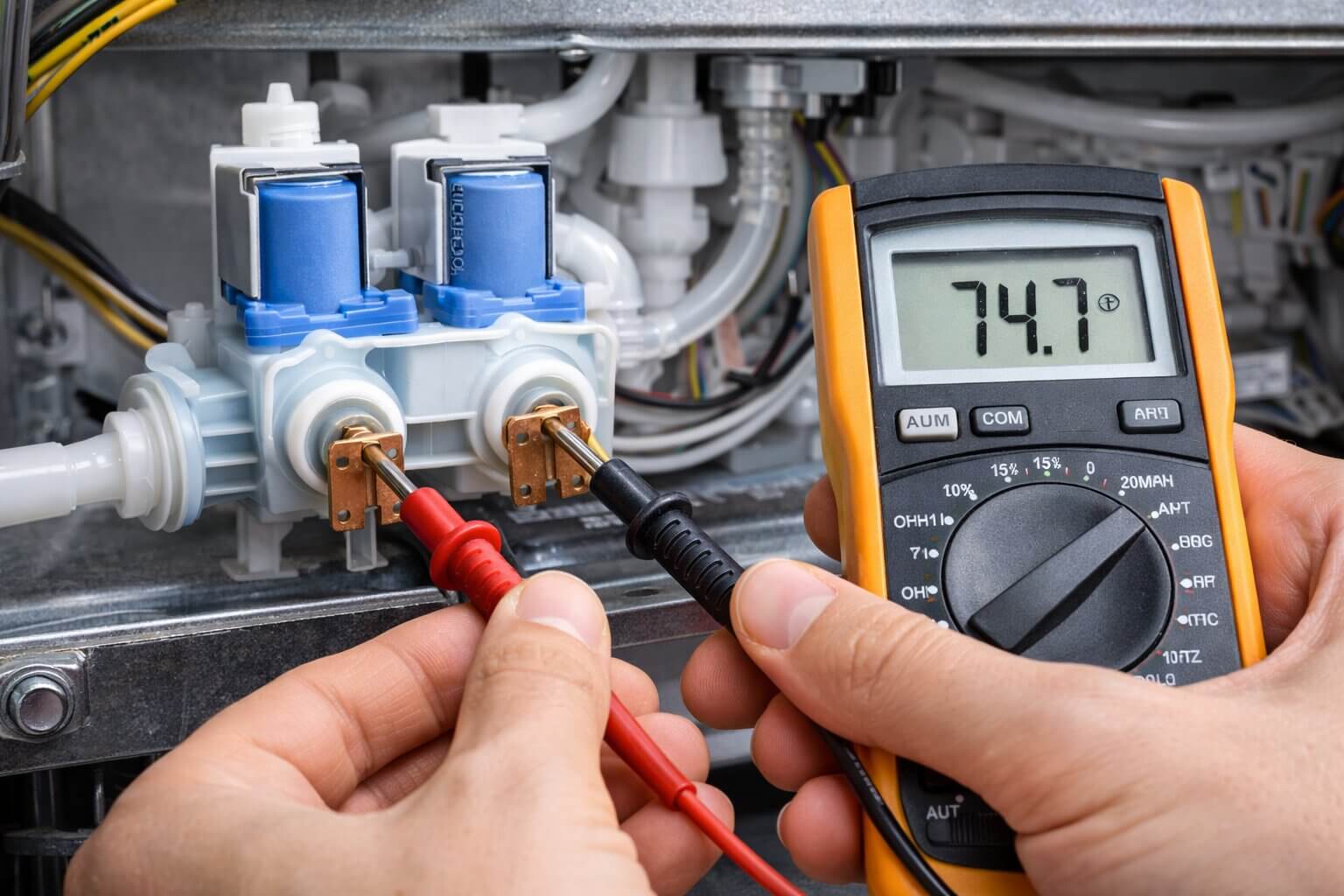
The Diagnostic Fix: Multimeter Testing
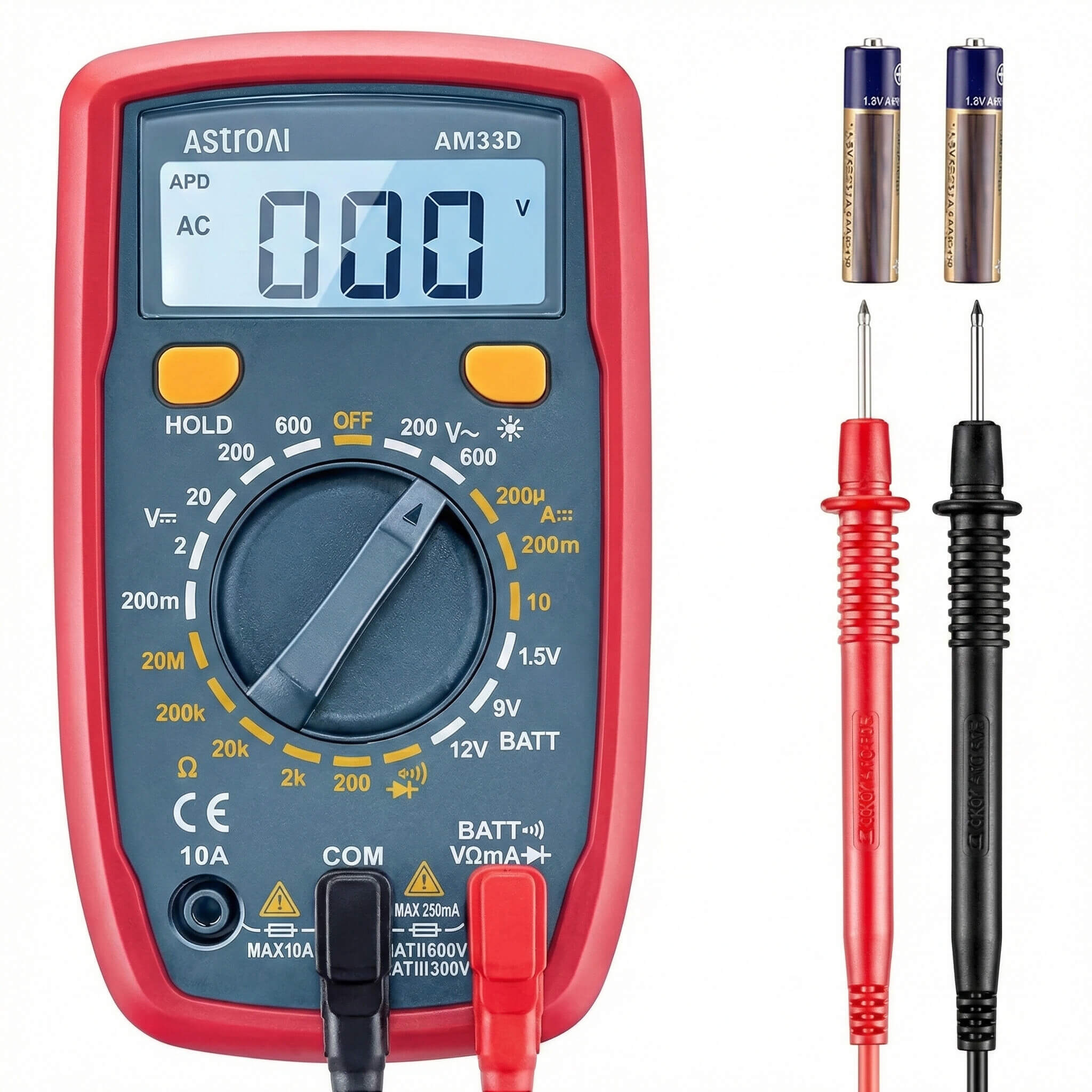
To definitively prove the valve has failed, you must utilize a digital multimeter to test the electrical continuity of the solenoid coils. (Always unplug the refrigerator from the wall before removing the rear access panel).
Set your multimeter to the Ohms (Resistance) setting. Touch the probes to the metal terminals on the solenoid. A healthy valve should read between 150 and 300 Ohms. If the solenoid tests perfectly fine electrically, but the water flow is still painfully slow, the internal mechanical gate is definitively clogged with calcium scale. The entire inlet valve assembly must be completely replaced.
Digital Multimeter for Appliance Repair
Why you need this: You cannot safely or accurately test a water inlet valve solenoid without a digital multimeter. This tool allows you to instantly check if the internal copper coils have burned out, saving you from blindly buying and replacing the wrong parts.
Conclusion
Experiencing incredibly slow water flow from your Samsung dispenser immediately after installing a brand new filter is highly annoying, but the good news is that it rarely requires an expensive service call from a professional appliance technician.
In 90% of cases, you are simply dealing with basic fluid dynamics. Brand new, dry filters introduce massive pockets of ambient air into your sealed water lines, creating a stubborn vapor lock. Always start your troubleshooting by grabbing a large pitcher and aggressively flushing 3 entire gallons of water through the system to push that air completely out. If the pressure doesn’t immediately return, pull the filter out, inspect the rubber O-rings, and forcefully reseat it to ensure the internal plunger valve is fully depressed.
Only after you have completely ruled out air locks, physical filter seating issues, and kinked hoses behind the fridge should you grab a digital multimeter and pull the fridge away from the wall to test the rear mechanical water inlet valve. With a little patience, you’ll have that crisp, high-pressure water back in no time.