
It is one of the most frustrating moments in home maintenance. You’ve done the responsible thing: you spent $50 on a brand-new Samsung water filter, spent ten minutes wrestling it into the housing, and reset that annoying red light. You pour yourself a cold glass of water, take a sip, and… it’s terrible. It tastes bitter, metallic, or like a mouthful of plastic.
If your fridge water tastes bad after changing the filter, your first instinct is likely to assume the filter is defective or that you’ve bought a counterfeit. While those are possibilities, they are rarely the culprit. In reality, the “bad” taste is usually the result of chemistry and physics that occur during the initial “priming” phase of a new filter. In this 1,500-word guide, we are going to dive deep into the science of carbon dust, the behavior of compressed air in water lines, and the mandatory “3-Gallon Flush” that determines the quality of your drinking water for the next six months.
💡 Mentor’s Quick Diagnosis
Most “bad tastes” are caused by carbon fines (black dust) and trapped air. Samsung, LG, and Whirlpool all mandate a 3-to-5-gallon flush to clear these out. If you only poured one glass, you haven’t even finished the installation yet! For a complete overview of installation procedures and troubleshooting, please refer to our main pillar guide.
The Science of Carbon Fines: Why the First Glass is “Grey”
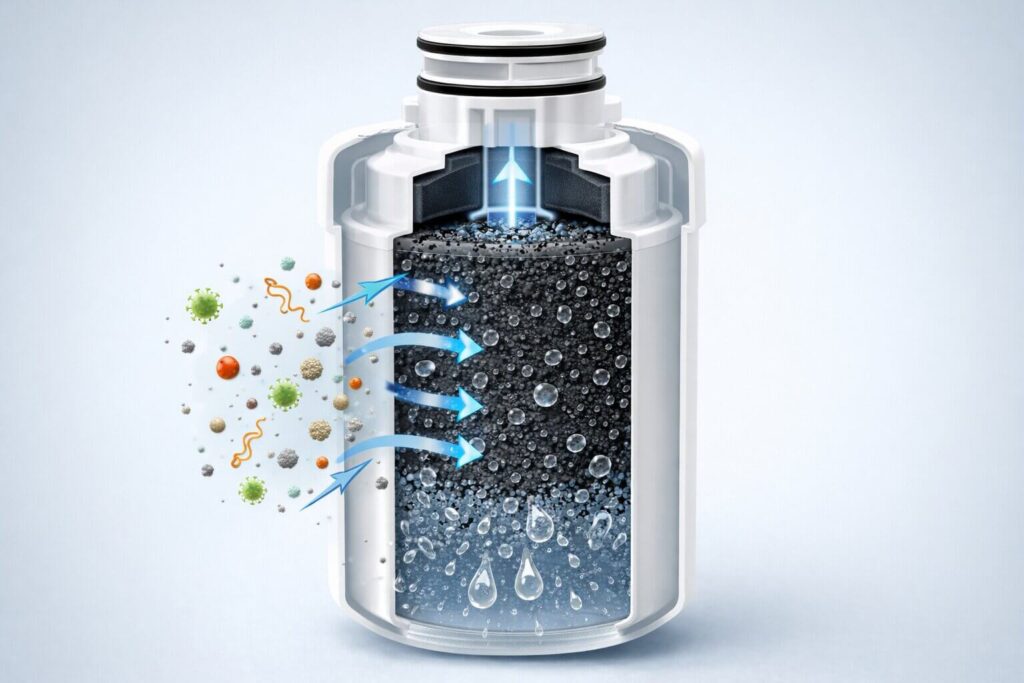
To understand why new water tastes bad, you have to understand what is inside that plastic cylinder. Almost all modern refrigerator filters, including the classic Samsung DA29-00020B and the newer square HAF-QIN (see our Bespoke Filter Replacement Guide), use an Activated Carbon Block.
What is Activated Carbon?
Activated carbon is usually made from organic materials like coconut shells or wood. These materials are heated to extremely high temperatures in a vacuum. This process “activates” the carbon by opening up millions of microscopic pores. A single gram of activated carbon has a surface area of over 3,000 square meters—roughly half the size of a football field. This massive surface area acts like a magnet, pulling chlorine, lead, and pesticides out of your water.
The Problem with Shipping
During the journey from the factory to your doorstep, that solid carbon block is subjected to vibrations, drops, and temperature changes. These forces cause the carbon block to rub against the plastic walls of the filter housing, creating a fine, microscopic powder known as “carbon fines.”
When you first turn on the water dispenser, the high-pressure water (usually between 40 and 60 PSI) hits that loose powder and flushes it directly into your glass. These fines are extremely bitter and have a “dry” charcoal mouthfeel. This is the primary reason for that initial “bad” taste.
Micro-Bubbles: The “Cloudy Water” Mirage
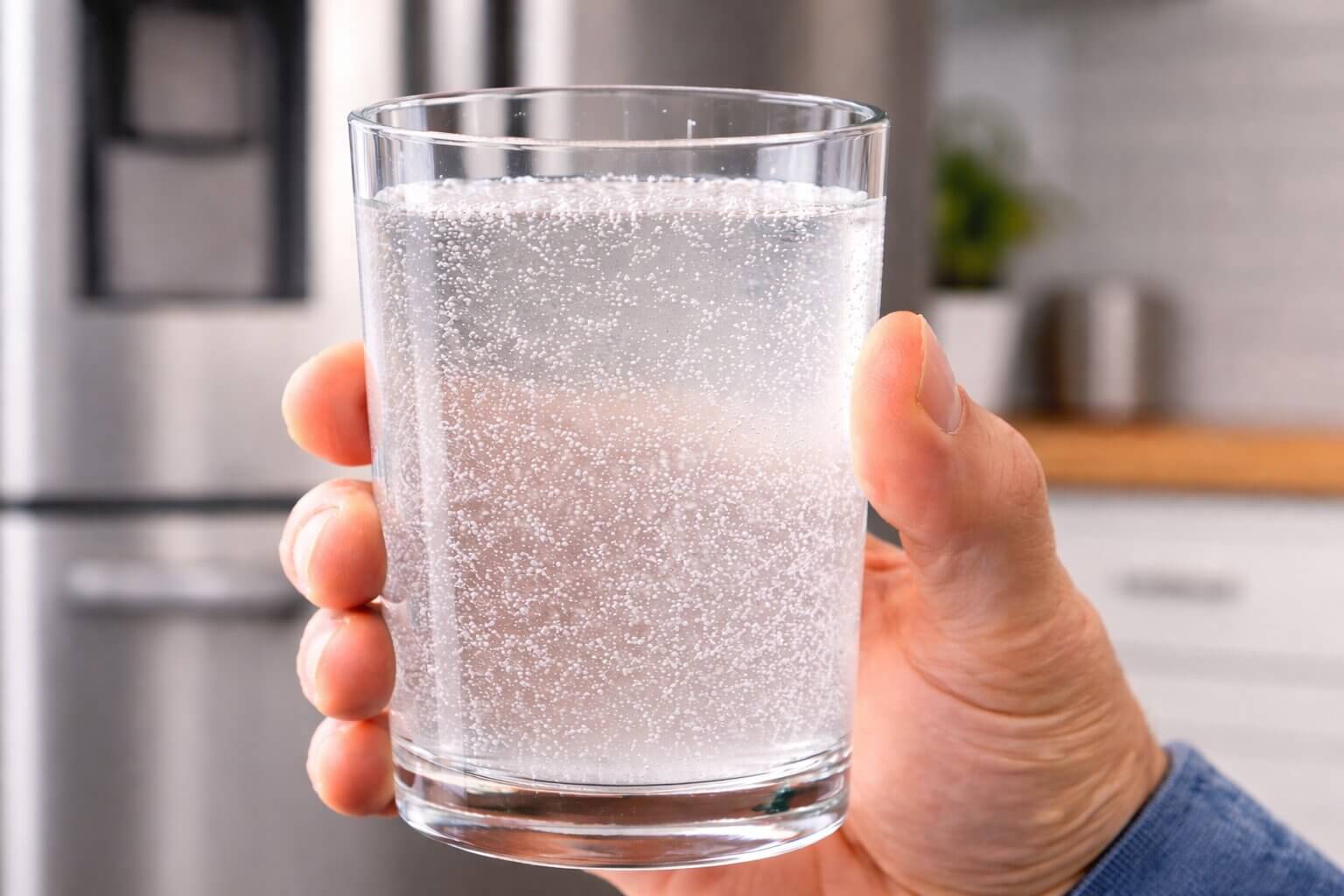
If your water looks “milky” or cloudy after a filter change, many homeowners fear that chemicals are leaching into the water. However, if you let the glass sit for 60 seconds and the cloudiness disappears from the bottom up, you are looking at compressed air.
When you swap filters, you introduce a massive amount of air into the refrigerator’s internal water lines. As the water fills the dry filter, it traps this air and breaks it down into billions of microscopic bubbles. These bubbles don’t just change the appearance of the water; they change the taste. Highly aerated water can taste “sharp” or “fizzy,” which many people interpret as a chemical or metallic flavor.
Why Does the Water Taste Like Plastic?
If the taste isn’t bitter (carbon) but rather “chemical-like,” the culprit is often the housing or the tubing. New filters are sealed at the factory. The plastic used in the housing and the rubber used in the O-rings can sometimes emit a “new part” odor. Because water is a universal solvent, it picks up these trace scents as it sits stagnant inside the new filter for the first few hours.
This is why the first glass of the morning often tastes the worst. The water has spent eight hours sitting in the new plastic housing, absorbing those “new part” molecules. A proper flush removes this stagnant water and conditions the plastic for regular use.
Digital TDS Water Quality Tester
Why you need this: A TDS (Total Dissolved Solids) meter tells you exactly how many impurities are in your water. If your water tastes “bad” but the meter shows a low number, you know it’s just harmless carbon dust and not actual contamination.
The Mandatory 3-Gallon Flush: Why “One Glass” Isn’t Enough
Most homeowners stop flushing once the water “looks” clear. This is a mistake. Clearing the visual dust is only half the battle; you also need to “wet” the entire depth of the carbon block to ensure chemical adsorption is actually happening.
Step-by-Step Conditioning Process:
- The Initial Burst: Dispense water for 30 seconds. You will hear hissing and sputtering. This is the air leaving the system.
- The 1-Gallon Mark: The water should be clear of black specks by now, but it will still taste “flat” or bitter.
- The 3-Gallon Goal: By the time you reach three gallons, you have successfully flushed the internal reservoir (which holds about 0.5 gallons) and the entire length of the lines.
- The “Ice Maker” Sacrifice: Your ice maker has its own internal line. If you don’t dump the first two full bins of ice, your drinks will taste like the very carbon fines you just tried to flush out.
When the Bad Taste Won’t Go Away
If you have flushed 5+ gallons and the water still tastes “off,” you are likely dealing with one of these three advanced issues:
1. Stagnant Biofilm in the Reservoir
If you waited 12+ months to change your filter, the water inside the fridge’s internal tank has been sitting still. This can lead to a “biofilm” (a thin layer of bacteria) growing inside the plastic lines. A new filter provides higher water pressure, which can actually “scrub” some of that old biofilm loose, making the taste worse temporarily. In this case, you may need to flush 10 gallons to fully clean the system.
2. The “Counterfeit” Filter Trap
If you bought a “bargain” filter on a 3rd-party marketplace, it may not use high-quality coconut shell carbon. Cheap coal-based carbon filters can leach a permanent “earthy” or “dirt” taste into the water that never goes away, no matter how much you flush. If the taste persists after 10 gallons, the filter is likely low-quality. See our Generic Filter Comparison Guide for rigorously tested brands you can trust.
3. Copper Line Oxidation
If you have an older home with copper water lines, the new filter’s increased flow can cause “scouring” of the copper pipes. This results in a sharp, metallic, penny-like taste. This is an issue with your home’s plumbing being agitated by the maintenance, not the fridge itself.
Conclusion: The “Break-In” Period is Real
A Samsung fridge water filter is a chemical engine. Like any engine, it has a break-in period. By understanding that carbon fines, micro-bubbles, and air pockets are a natural part of the process, you can save yourself the stress of an unnecessary return. Just remember: 3 gallons for the dispenser, and 2 bins for the ice maker. Once that is done, your water will be as crisp and clean as the day you bought the fridge.