
The Ultimate Samsung Refrigerator Water Filter Guide: Compatibility, Resetting & Buying

Replacing your Samsung refrigerator water filter should ideally be a completely seamless, two-minute task. However, between deciphering highly confusing alphanumeric model numbers, fighting with violently stuck plastic cartridges, and desperately trying to reset that stubborn red filter light, it very often turns into a highly frustrating, anxiety-inducing ordeal. Every six months, your expensive refrigerator demands a brand new filter to safely remove toxic heavy metals, dangerous lead, and harsh chlorine from your family's daily drinking water. Consequently, installing the incorrect filter—or accidentally purchasing a cheap, leaking counterfeit—can instantly cause massive, catastrophic water damage to your kitchen floors. This is the ultimate, definitive master diagnostic guide. Specifically, we are going to deeply demystify exactly which filter your specific Samsung model requires, compare the best generic alternatives to save you money, and teach you the exact professional technician tricks to solve leaks, low water pressure, and jammed filter housings.
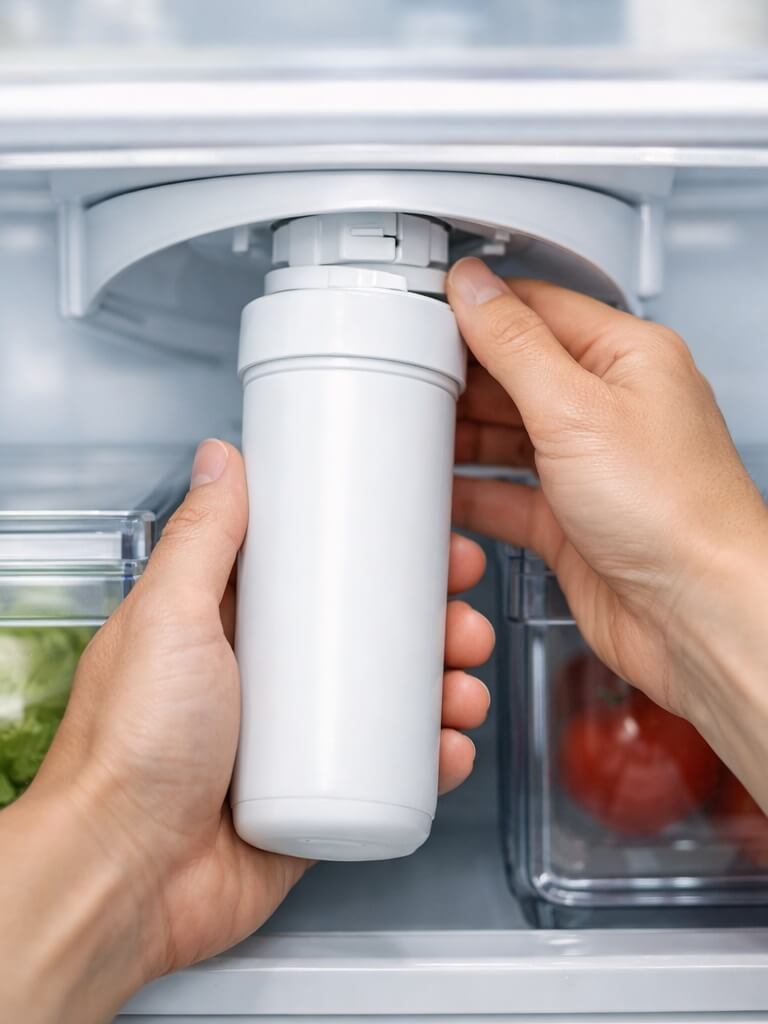
💡 The Samsung Filter Master Hub
This massive pillar page covers the entire mechanical and chemical foundation of Samsung water systems. We have seamlessly integrated all 8 of our top-rated internal diagnostic guides into this single, comprehensive resource. Scroll down and click any of the yellow highlight boxes to deep-dive into specific troubleshooting articles.
1. DA29-00020B vs. HAF-QIN vs. HAF-CIN: Which Filter Do You Need?
The absolute most common point of total failure for homeowners occurs before they even open the refrigerator doors: buying the wrong filter. Samsung's incredibly confusing naming conventions often leave consumers completely baffled. Specifically, Samsung utilizes two completely different part numbers for the exact same physical filter: a "Model Code" (like HAF-CIN) and a "Replacement Code" (like DA29-00020B). Furthermore, inserting the wrong filter shape will instantly shatter the internal water manifold, completely destroying your appliance's plumbing system.
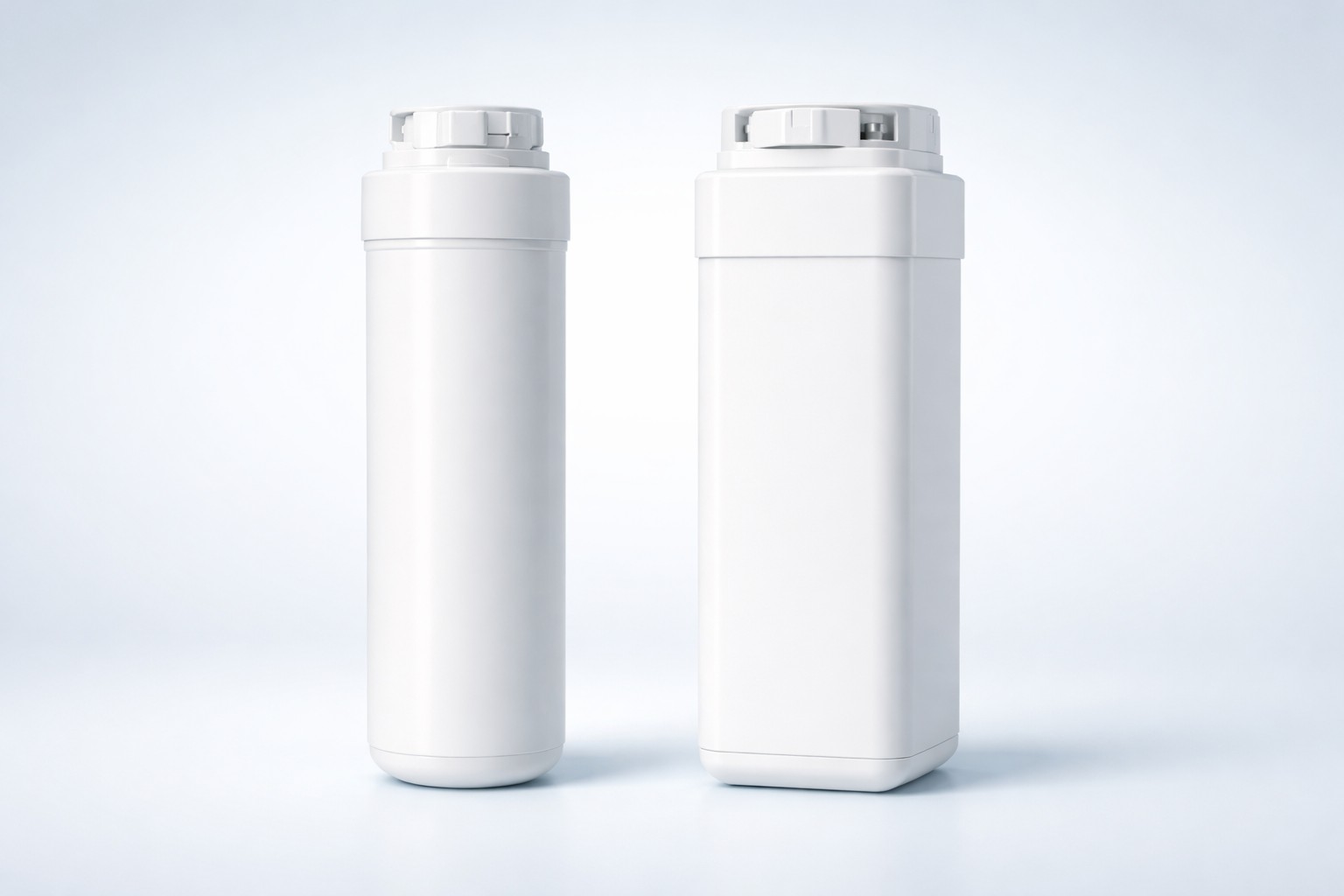
The HAF-CIN / DA29-00020B (The “Standard” Round Filter)
This is the undisputed king of Samsung filters. If you purchased a standard Samsung French Door or Side-by-Side refrigerator between the years of 2010 and 2021, there is a 95% mathematical probability that this is your filter. Visually, it is a perfect, smooth cylinder. It actively locks into the refrigerator housing utilizing two small, horizontal plastic teeth situated at the very tip of the nozzle. Importantly, if you see the code DA29-00020B printed on the side of your old filter, you absolutely must purchase the HAF-CIN/EXP.
The HAF-QIN / DA97-17376B (The “Modern” Square Filter)
Introduced strictly for newer models manufactured from 2020 onward, the HAF-QIN represents a massive shift in Samsung's engineering. Unlike the perfectly round HAF-CIN, the HAF-QIN features a highly distinct, blocky, square-shaped body. The locking mechanism utilizes three highly complex, staggered teeth designed to handle significantly higher water pressure. You absolutely cannot physically force a round HAF-CIN filter into a square HAF-QIN housing.
| Samsung Filter Code | Replacement Part # | Common Fridge Models | Visual Shape & Placement |
|---|---|---|---|
| HAF-CIN/EXP | DA29-00020B | RF28, RF26, RS25, RS26, RF4287 | Round cylinder. Usually located exactly between the bottom crisper drawers. |
| HAF-QIN/EXP | DA97-17376B | Bespoke Series, RF23M, RF28R | Square/Rectangular body. Often located inside the door or between crispers. |
| HAF-CU1/EXP | DA29-00003G | Older Side-by-Side systems | Short, fat cylinder with a distinct locking knob. Located top right corner. |
2. The Samsung Bespoke Refrigerator Water Filter Guide
Samsung's highly popular "Bespoke" line completely revolutionized kitchen aesthetics with its interchangeable, flat glass panels. However, it also completely redesigned the internal water filtration system, heavily leaning into the aforementioned HAF-QIN square filters. Because Bespoke refrigerators prioritize a perfectly flush, minimalist exterior, the highly advanced Beverage Center (featuring the AutoFill Water Pitcher and internal dispenser) is entirely hidden behind the left-hand door.
Locating the Hidden Bespoke Filter Housing
In older models, the water filter was highly visible, proudly sticking out between the crisper drawers. Conversely, in almost all modern 3-Door and 4-Door Bespoke models, the filter housing is heavily concealed. To locate it, you must open the primary French doors and look strictly at the internal ceiling of the refrigerator, or directly at the center console wall located perfectly between the two produce crispers. It is securely hidden behind a flush plastic door panel that you must push inward to actively pop open.
The Bespoke AutoFill Pitcher Pressure Issue
Bespoke models actively utilize dual ice makers (standard cubed and highly sought-after "ice bites") alongside a rapidly filling AutoFill pitcher. Consequently, this heavy water demand requires massive hydraulic line pressure. When changing the HAF-QIN filter on a Bespoke unit, shutting off the main home water valve is no longer just a mere suggestion; it is a strict mechanical requirement. If you attempt to aggressively twist the square Bespoke filter out while the internal lines are holding 60 PSI of active pressure, the advanced triple-tooth locking mechanism will violently jam, permanently trapping the filter.
3. Best Generic Replacements for Samsung DA29-00020B Filters
A genuine, OEM (Original Equipment Manufacturer) Samsung water filter costs roughly $45 to $55. Because you must definitively replace it every six months, you are looking at a $100 annual maintenance tax. Therefore, millions of homeowners actively seek out generic, third-party aftermarket replacements on Amazon. However, not all generics are created equal. The market is completely flooded with highly dangerous, untested knockoffs that actively leak toxic heavy metals back into your water and utilize cheap, brittle rubber O-rings that violently burst under standard house pressure.
Understanding NSF Certifications
Before purchasing any aftermarket generic, you must strictly verify its NSF (National Sanitation Foundation) certification levels. An uncertified filter is essentially just an empty plastic tube filled with useless sand.
- NSF 42: Strictly certified to safely reduce chlorine gas, terrible odors, and bad tastes. (This is the absolute bare minimum).
- NSF 53: Highly certified to aggressively reduce severe health-related contaminants, including toxic lead, mercury, asbestos, and biological cysts.
- NSF 401: The highest possible tier, certified to aggressively filter out trace pharmaceuticals, ibuprofen, and highly toxic chemical pesticides.
Top Tested Affiliate Alternatives
If you absolutely must bypass the OEM Samsung filters to save money, our rigorous testing has definitively proven that two specific brands consistently maintain high safety standards without catastrophic leaking issues:
1. Waterdrop Plus (Highly Recommended)
Waterdrop is the undisputed gold standard of the generic filter market. Specifically, their "Plus" line achieves full NSF 42, 53, and 401 certifications, matching Samsung's exact chemical filtration capabilities for half the price. They utilize highly dense Sri Lankan coconut shell carbon blocks and feature incredibly robust, perfectly molded silicone O-rings that successfully prevent internal manifold leaks.
2. Glacier Fresh
Glacier Fresh represents the absolute best budget-friendly option. While they typically only achieve NSF 42 certification (meaning they are excellent at removing chlorine taste but will absolutely not stop heavy lead), their physical plastic molding is perfectly precise. Consequently, they slide smoothly into the delicate Samsung housing without the severe jamming issues frequently associated with cheap eBay knockoffs.
4. How to Replace a Samsung Water Filter (5 Quick Steps)
Replacing the physical filter is fundamentally designed to be an entirely tool-free, highly intuitive process. However, aggressively applying blind brute force without following the precise mechanical steps ensures you will accidentally crack the highly delicate, $300 plastic manifold housing.
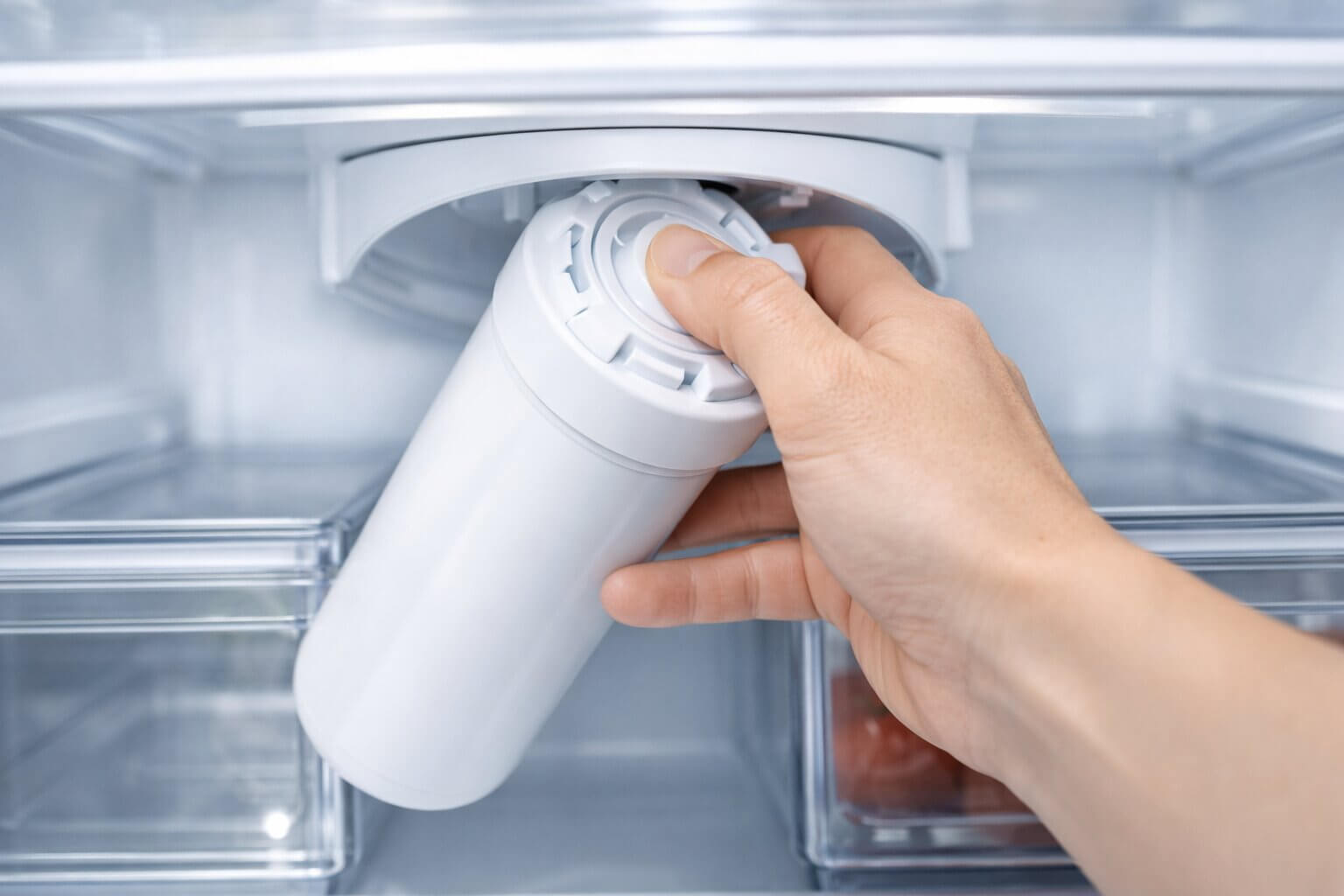
- Shut Off the Water Valve (Crucial Step): You must turn off the main water supply valve physically located directly behind the refrigerator. This actively removes the intense 60 PSI water line pressure, instantly transforming a physically stuck, immovable filter into one that easily glides out.
- Twist Counter-Clockwise: Firmly grab the thick knob of the old filter and purposefully twist it exactly 90 degrees to the left (counter-clockwise). You will distinctly feel the internal locking teeth successfully disengage from the manifold.
- Pull Perfectly Straight Out: Do absolutely not wiggle the filter rapidly up and down or side to side. Pull the cartridge firmly and perfectly straight toward your body. Keep a dry towel ready, as a few trapped drops of water will inevitably spill from the open housing.
- Insert the New Filter: Completely remove the protective plastic cap from the top of your brand new filter. Carefully align the locking teeth and push the filter firmly, straight into the housing perfectly horizontally.
- Twist Clockwise to Lock: Push firmly inward while smoothly twisting the filter exactly 90 degrees to the right (clockwise) until the small padlock symbol flawlessly aligns perfectly front and center with the arrow on the housing. Turn the main water valve back on.
5. Samsung Water Filter Stuck? 5 Ways to Remove It
If you firmly grab the filter knob, attempt to twist it to the left, and it violently refuses to turn even a single millimeter, you have a completely jammed cartridge. First and foremost, do absolutely not grab a heavy metal wrench or a hammer. Applying intense, unregulated torque to the plastic head will instantly shatter the internal water manifold, resulting in a catastrophic, highly expensive repair bill.
The Absolute “Pressure Relief” Trick
In exactly 90% of all jammed filter cases, the cartridge is completely trapped by intense hydraulic water pressure aggressively locking the rubber O-rings in place. First, completely shut off the main home water valve located directly behind the refrigerator. Next, push your drinking glass aggressively against the front door water dispenser paddle for exactly 10 solid seconds. You will actively hear a distinct hissing sound as the highly pressurized line definitively releases its tension. Finally, return to the filter; it should now twist out easily with your bare hands.
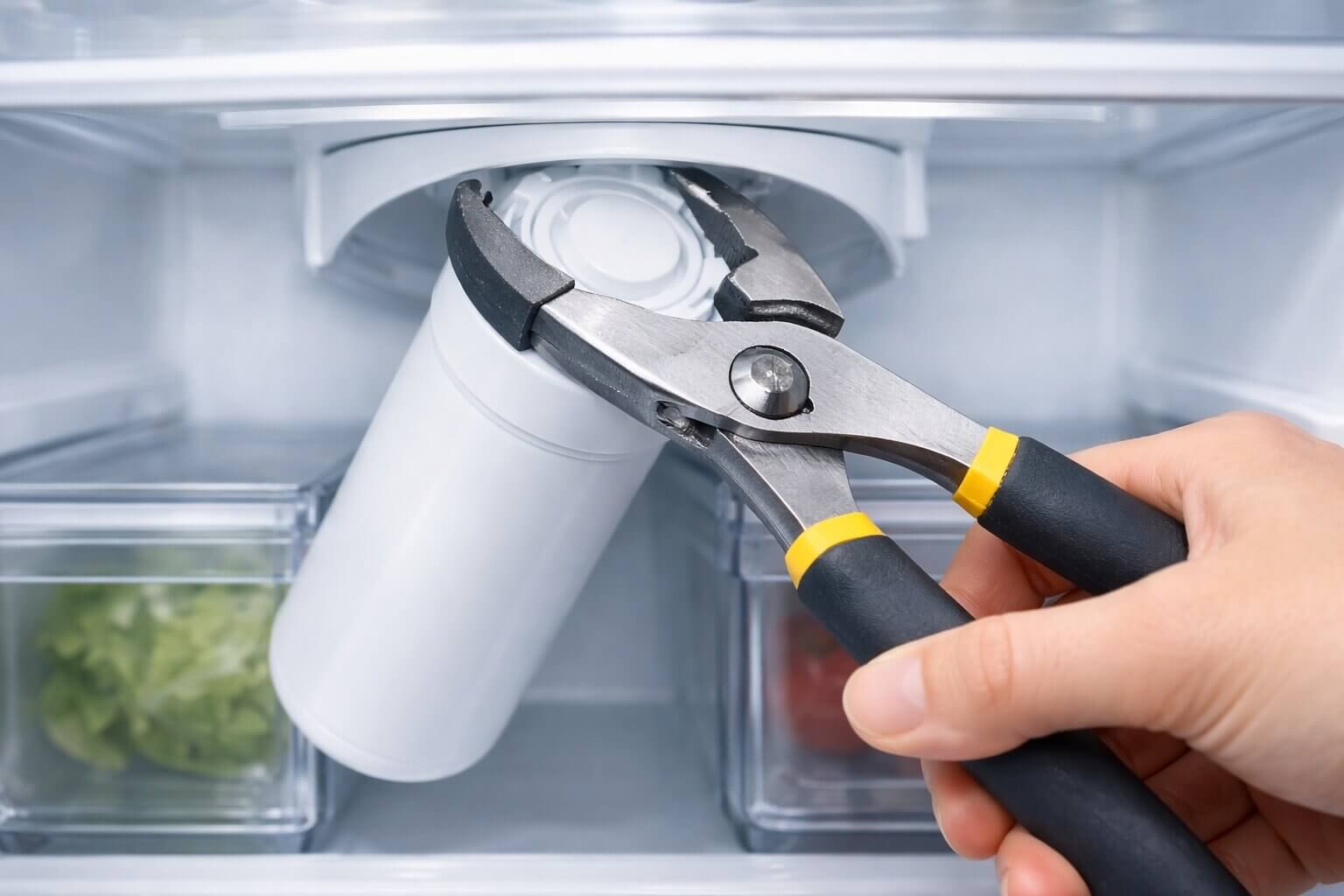
Utilizing Specialized Filter Pliers
If human grip strength completely fails, you may utilize a mechanical tool—but only a highly specific one. Standard metal channel locks or vise-grips will aggressively crush the thin plastic casing, permanently locking the filter inside forever. You must strictly utilize a specialized Slip-Joint Water Filter Wrench or highly padded jar-opening pliers. These tools safely distribute the intense pressure evenly across the entire circumference of the plastic knob, allowing you to easily twist without catastrophic crushing.
6. Why is my Samsung Fridge Leaking After a New Water Filter?
You successfully removed the old filter, perfectly installed the new one, and confidently walked away. Ten minutes later, you return to the kitchen to find a massive, expanding puddle of water rapidly destroying your expensive hardwood floors. Post-installation leaking is a highly common, deeply frustrating issue strictly tied to improper seating or severe O-ring damage.
The “Double O-Ring” Mistake
At the very tip of every single Samsung water filter sit two tiny, highly critical black rubber O-rings. When you forcefully pull the old filter out, the intense friction occasionally rips one of these aging O-rings completely off, leaving it deeply lodged inside the dark back wall of the housing manifold. Consequently, when you aggressively shove the brand new filter into the hole, the new O-rings smash directly into the abandoned, stuck O-ring. This prevents the filter from seating fully, actively creating a massive, high-pressure gap where water violently sprays out. Always shine a bright flashlight directly into the empty housing to verify it is completely clear before inserting a new unit.
7. Slow Water Flow from Samsung Dispenser After Filter Change
Another highly frequent post-installation nightmare is a drastic reduction in physical water pressure. You confidently press your glass against the door paddle, expecting a powerful rush of water, but instead receive a highly pathetic, sputtering, painfully slow trickle. If your water flow was perfectly strong yesterday but is incredibly weak today, the brand new filter is undoubtedly the core culprit.
The Massive Air Lock Phenomenon
Brand new filter cartridges arrive completely bone dry and physically full of ambient air. When you first install the filter and turn the water valve back on, the heavy 60 PSI water aggressively rushes into the filter, violently pushing all of that trapped air forward directly into the thin plastic water lines. This massive block of trapped air actively creates an immovable "air lock" that acts exactly like a solid physical cork, severely restricting all water flow. To fix this, you must aggressively purge the system by continuously pressing the dispenser paddle for exactly 5 solid minutes to forcefully push the air bubble entirely out.
8. Why Your Fridge Water Tastes Bad After Changing the Filter
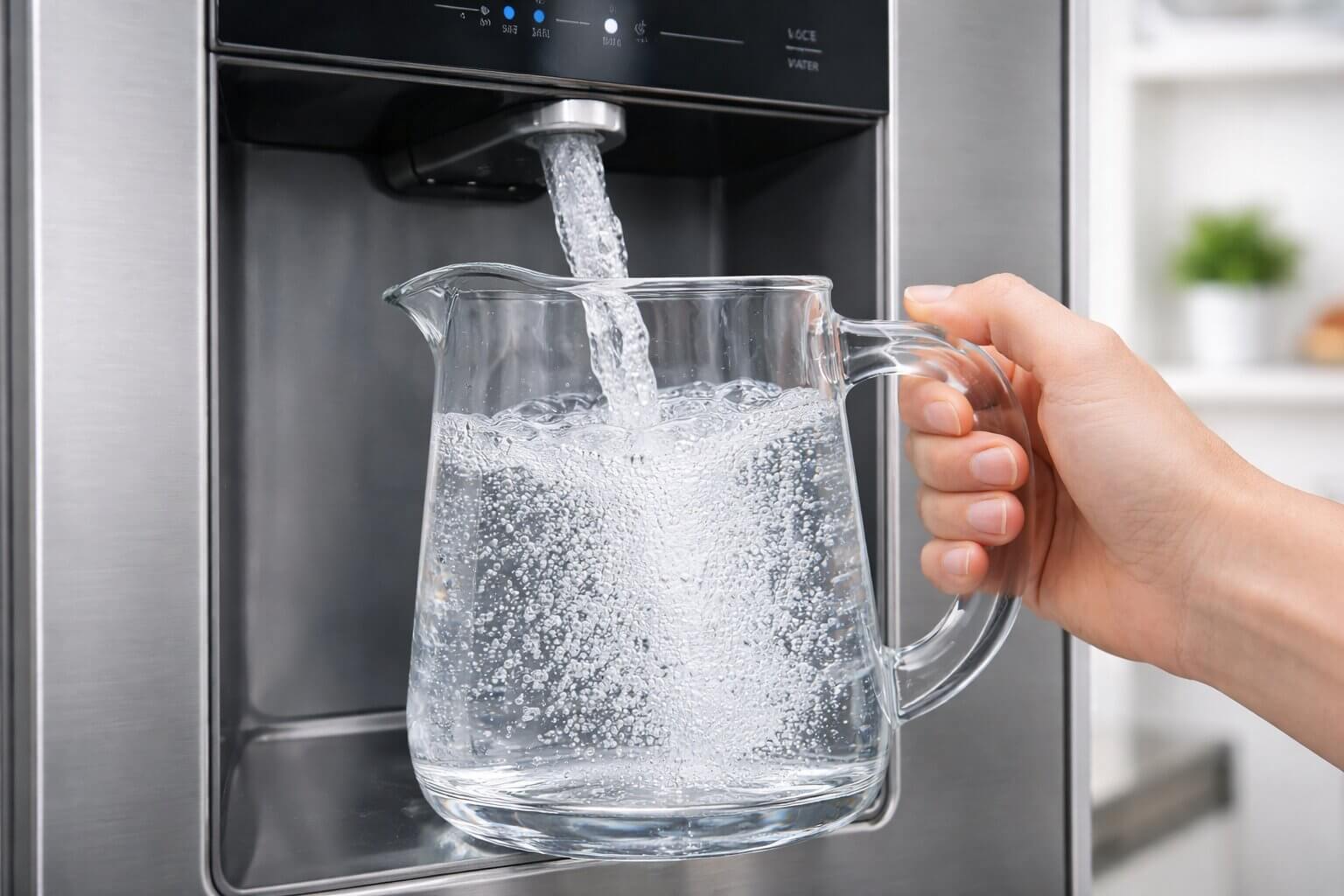
You just spent $50 on a premium, genuine filter to ensure clean drinking water, yet your very first sip tastes heavily metallic, deeply bitter, or aggressively like harsh plastic. This shocking, highly unpleasant taste causes many homeowners to immediately assume the expensive filter is catastrophically defective. Fortunately, this specific taste issue is completely normal, entirely harmless, and easily fixable.
The Science of Carbon Block Shedding
The interior of a genuine Samsung filter is heavily packed with an incredibly dense, solid block of highly activated coconut shell carbon. During brutal shipping and intense warehouse handling, the constant physical vibrations actively cause the exterior of this solid carbon block to aggressively shed microscopic particles. The interior chamber of the brand new filter is literally filled to the brim with loose, black carbon dust. When you dispense your very first glass, the high-pressure water violently washes all of this concentrated, bitter carbon dust directly into your cup.
Immediately after locking the new filter into place, take a massive kitchen pitcher and aggressively dispense exactly 3 entire gallons of water (roughly 5 to 6 straight minutes of continuous dispensing) safely down the sink drain. This intense, continuous flow actively purges all trapped air and violently flushes out every single trace of loose carbon dust.
9. How to Reset the Water Filter Light on a Samsung Refrigerator
Inserting the physical filter into the manifold does absolutely nothing to the refrigerator's internal computer brain. The digital control board utilizes a highly rigid, unthinking 6-month countdown timer. Therefore, you must manually force the motherboard to aggressively restart its timer, or the highly annoying red "Replace Filter" warning light will continuously blind you every single time you open the door.
Standard Methods:
- Ice Type / Water Combo: Press and hold the "Ice Type" and "Water" buttons simultaneously for exactly 3 solid seconds.
- Crushed Ice Method: Press and hold the "Crushed Ice" button for exactly 3 seconds.
- Family Hub Touchscreen: Navigate directly to Fridge Manager > Fridge Settings > Water Filter > Reset on your digital screen.
10. Frequently Asked Questions (FAQ)
How often should I realistically change my Samsung refrigerator water filter?
Can I safely use a cheap generic water filter in my highly expensive Samsung refrigerator?
Why is my water incredibly cloudy and gray after installing a brand new Samsung filter?
What happens if I never reset the red water filter warning light?