
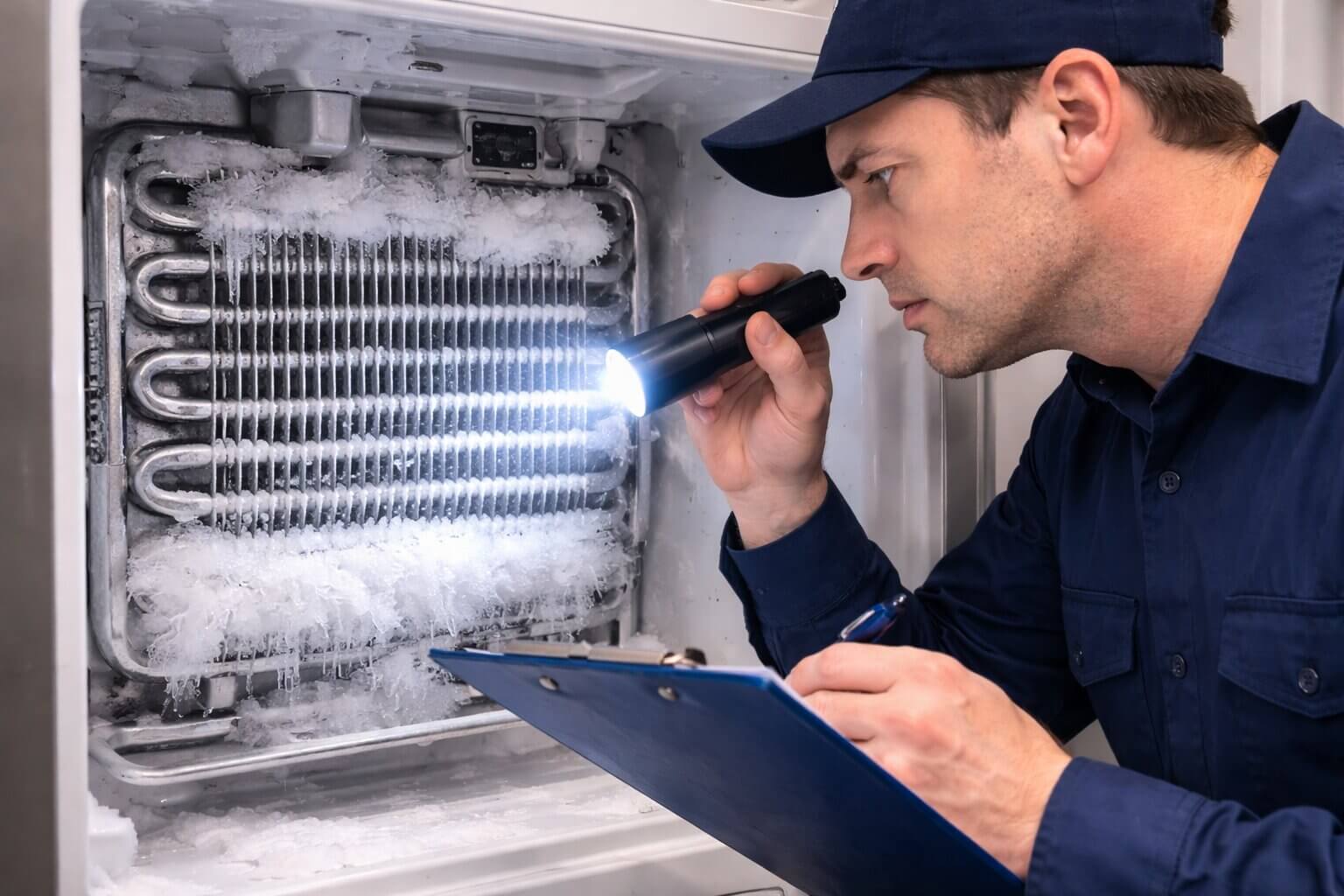
If you want to know exactly what is wrong with your refrigerator without guessing, you need to learn the greatest secret in appliance repair: reading the frost pattern. When a professional technician walks into a kitchen for a “not cooling” service call, they don’t immediately start testing motherboards or replacing compressors. Instead, they go straight to the freezer, take off the back wall, and look at the evaporator coils.
The aluminum evaporator coil is the heart of your refrigerator’s cooling system. As liquid refrigerant boils into a gas inside these tubes, it absorbs heat, causing the metal fins to drop to sub-zero temperatures. Because of this, the moisture in the air naturally freezes onto the coils.
The way this frost forms—the refrigerator evaporator frost pattern meaning—tells you a complete, undeniable story about the health of your compressor, your defrost system, and your refrigerant levels.
In this advanced diagnostic guide, we are going to teach you how to think like a master technician. We will show you how to remove fridge back panel safely, how to identify the “perfect” frost pattern, what partial frost pattern symptoms mean, and the definitive way to diagnose a sealed system leak vs fan failure.
Phase 1: How to Remove Fridge Back Panel
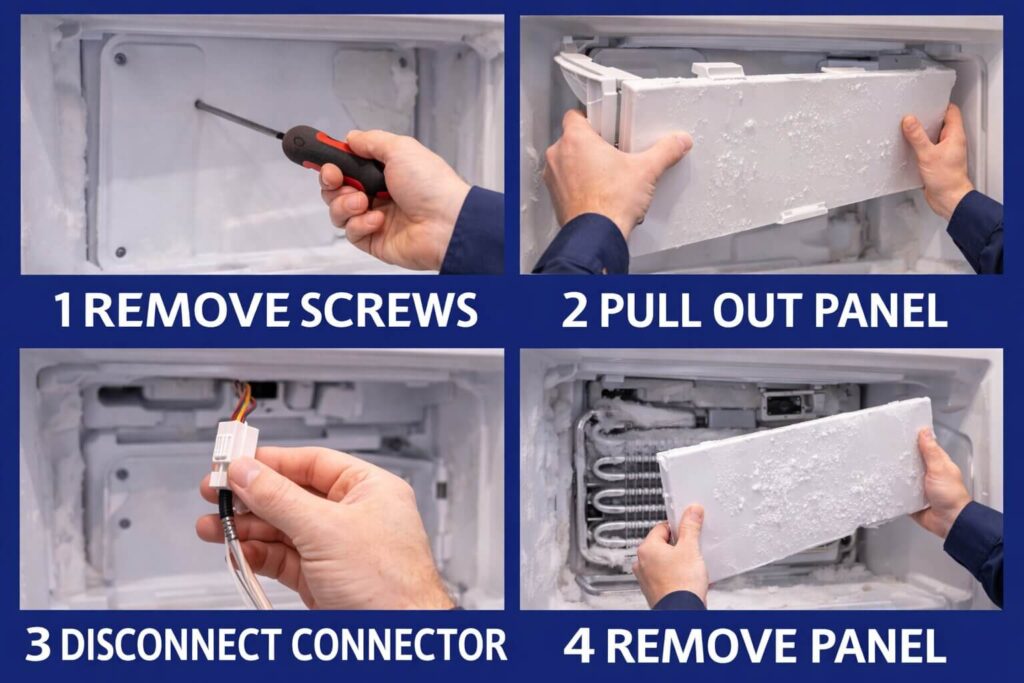
To read the frost pattern, you must physically expose the evaporator coils. In 95% of refrigerators, these coils are hidden behind the rear inside wall of the freezer compartment.
Safety Warning: Always unplug your refrigerator before disassembling interior panels, as you will be working near live electrical wires for the fan and defrost heater.
Step-by-Step Access:
- Empty the Freezer: Remove all food, wire racks, and the ice maker bin. If you have a bottom-mount freezer drawer, you will likely need to lift the drawer completely off its glides to access the back wall.
- Locate the Screws: Look at the rear plastic or metal panel. You will typically find four to six screws holding it in place. Most brands (Whirlpool, GE, Frigidaire) use standard 1/4-inch hex head screws.
- Remove the Panel: Once the screws are out, gently pull the panel forward. Be careful! The evaporator fan motor is often mounted directly to this panel. You will need to unclip the plastic wire harness connecting the fan to the fridge before you can completely remove the wall.
- Inspect Immediately: Do not wait. Look at the coils the second you remove the panel, before the warm room air has a chance to melt the evidence.
Phase 2: The “Perfect” Frost Pattern (Normal Operation)
Before you can spot a problem, you need to know what a healthy system looks like.
If your sealed refrigeration system is operating flawlessly, the evaporator coils will have a light, powdery, even coating of white frost across every single inch of the tubing.
It should look like a delicate dusting of powdered sugar. You should clearly see the outline of the aluminum fins, and air should easily be able to pass through the gaps. If you see this perfect pattern, but your fresh food compartment is still warm, your cooling system is fine. Your issue is an airflow problem, usually caused by a blocked air damper.
Phase 3: The “Solid Block of Ice” (Defrost System Failure)
If you remove the back panel and are greeted by a massive, solid glacier of ice that completely entombs the metal coils, you do not have a cooling problem—you have a heating problem.
Refrigerators must run an automatic defrost cycle every 8 to 12 hours. A glass-tube heater at the bottom of the coil turns on, melts the powdery frost, and allows the water to drain away. If the defrost heater, the defrost thermostat (bi-metal), or the main control board fails, the frost builds up layer by layer until it becomes a solid block of ice.
The Symptoms:
When the coil is a solid block of ice, the evaporator fan cannot pull any cold air through the fins. The freezer will stay cold (because it’s filled with ice), but the fresh food section will warm up. (If this sounds exactly like your current situation, read our dedicated troubleshooting guide: Refrigerator Not Cooling But Running? to test your defrost heater.)
Phase 4: Partial Frost Pattern Symptoms (The Death Sentence?)
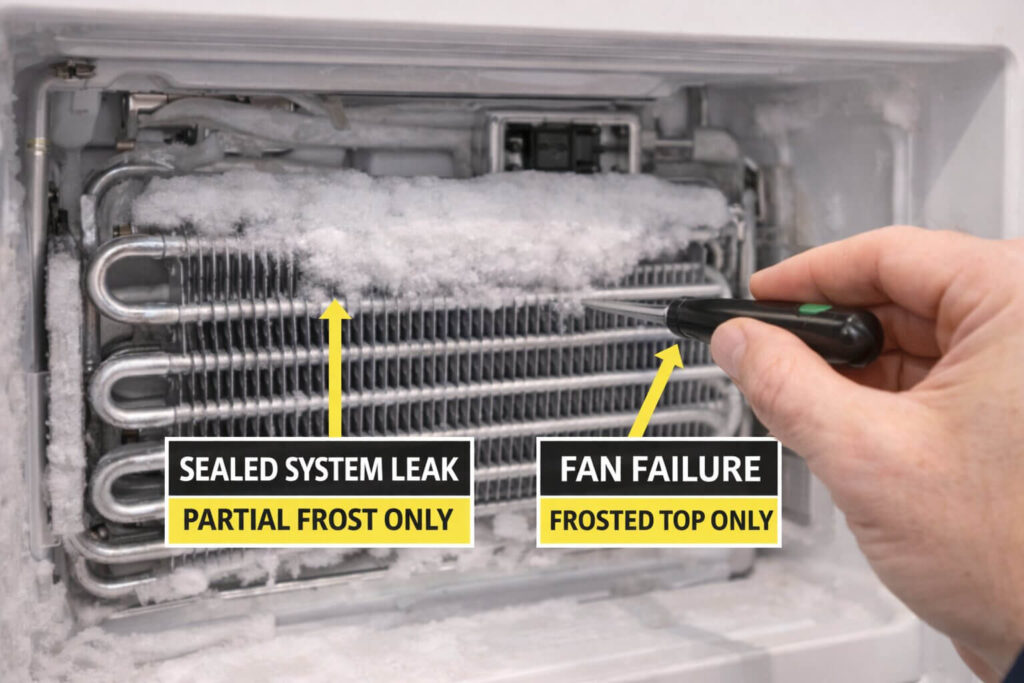
This is where your new technician skills truly come into play. A partial frost pattern is the most critical diagnostic clue you can find.
If you look at the coils and see a thick, hard ball of ice on the very top corner where the copper tube enters the aluminum fins, but the rest of the coil is completely bare, dark, and wet, you are experiencing classic partial frost pattern symptoms.
This means the liquid refrigerant is boiling off immediately as it enters the coil, and there is not enough freon left to cool the bottom 90% of the evaporator.
Diagnosing: Sealed System Leak vs Fan Failure
When a technician sees a partial frost pattern, they immediately have to determine if it is a catastrophic sealed system leak, a failing compressor, or just a dead fan.
1. The Evaporator Fan Failure
If the fan motor that blows air over the coils dies, the cold air just sits on the coils. Over several days, this can cause a strange, dense frost buildup, usually localized near the top. However, if it is a fan failure, the entire coil will eventually get incredibly cold to the touch.
2. The Sealed System Leak (Freon Leak)
If your system has a microscopic puncture in the copper tubing, the freon gas slowly escapes. Without enough freon, the compressor runs continuously trying to reach temperature, creating that localized ball of ice at the capillary tube inlet. (Have you noticed a strange, metallic, or nail-polish-like odor in your kitchen recently? Freon leaks have a distinct scent. Check out our guide on Why Does My Refrigerator Smell Like Chemicals for more clues.)
3. The Weak Compressor
If the compressor internal valves are worn out, it cannot pump the freon with enough pressure to push the liquid all the way through the large evaporator coil, resulting in the exact same partial frost pattern as a leak. (Because the fridge never reaches the target temperature, the compressor will never shut off. If your fridge is incredibly noisy and running 24/7, read: Why Is My Refrigerator Running Constantly?)
The Verdict: If you have a partial frost pattern (a ball of ice on a bare coil), and the evaporator fan is spinning normally, you have a sealed system failure (a leak or a bad compressor). Unfortunately, this requires a licensed EPA technician with welding equipment to fix, and is often the “death sentence” for an older refrigerator.
Phase 5: Completely Bare Coils (No Frost)
What if you remove the back panel, the compressor is humming away in the back, but the evaporator coils are completely bare? They aren’t even cold to the touch; they are room temperature.
This indicates a complete and total loss of refrigerant, or a completely seized compressor. The motor is running, but it is pumping absolutely nothing.
⚠️ Technician Pro-Tip:
If you find completely bare coils or a severe partial frost pattern, do not throw money at a new control board or thermostats. The problem is in the sealed tubing. Unless the refrigerator is less than 5 years old and under a manufacturer’s sealed-system warranty, it is almost always more cost-effective to replace the entire appliance than to pay for a compressor replacement and freon recharge.
Summary: The Frost Pattern Translation Table
| Frost Appearance | What It Means | Next Steps / The Fix |
|---|---|---|
| Light, Even, Powdery Frost | System is perfect. Normal operation. | Check air dampers for blockages. |
| Solid, Thick Block of Ice | Defrost System Failure. | Test Defrost Heater & Thermostat. |
| Ice Ball on Top / Bare on Bottom | Freon Leak or Weak Compressor. | Call a licensed sealed-system technician. |
| Completely Bare & Warm | Total Freon Loss or Dead Compressor. | Replace the refrigerator. |
Frequently Asked Questions
Is it normal for the back panel of my freezer to feel warm?
No. The interior back panel of your freezer covers the evaporator coils, which should be the coldest part of the entire appliance. If the plastic panel feels warm to the touch, it often means your defrost heater is stuck in the “ON” position, which will rapidly melt your food and requires immediate attention to the control board or defrost bi-metal thermostat.
Can I recharge the freon in my refrigerator myself?
Unlike older car air conditioners, modern household refrigerators do not have service ports (Schrader valves) installed from the factory. The system is crimped and brazed shut. To recharge a refrigerator, a licensed technician must physically cut the copper lines, weld on a new service port, pull a deep vacuum on the system to remove moisture, and weigh in the exact micro-ounce charge of R134a or R600a refrigerant. It is not a DIY job.
How long does it take for a frost pattern to form?
If you have completely thawed your refrigerator to perform a repair, it takes time for the sealed system to stabilize. You must plug the refrigerator in and let the compressor run with the doors closed for at least 30 to 45 minutes before a true, readable frost pattern will develop on the bare aluminum coils.